Codex AI Models Explained: GPT-5.6 Sol, Terra, Luna, GPT-5.5, GPT-5.4 Mini, and Claude Fable 5
Key takeaways
A practical, source-based guide to the Codex model selector: when to use GPT-5.6 Sol, Terra, Luna, GPT-5.5, GPT-5.4, GPT-5.4 Mini, and how they compare with Claude Fable 5.
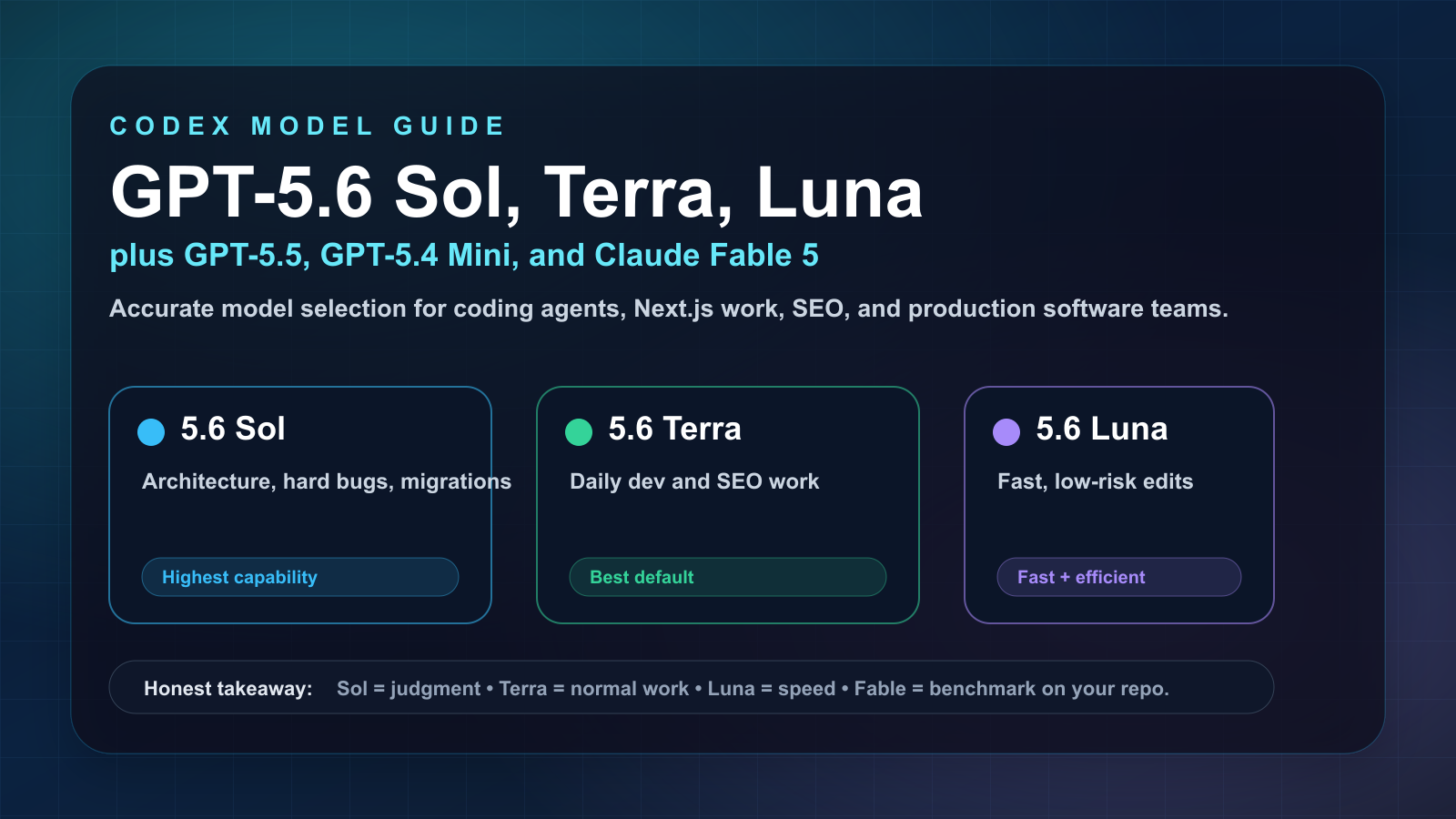
Short answer: in Codex, choose GPT-5.6 Sol when the task is hard, ambiguous, or high-impact; choose GPT-5.6 Terra for most everyday coding work; choose GPT-5.6 Luna when speed and cost matter more than frontier reasoning; keep GPT-5.5 and GPT-5.4 for compatibility or comparison; use GPT-5.4 Mini only for lightweight, low-risk work. Claude Fable 5 is a serious frontier competitor, but it is not always the same kind of product choice because safeguards, pricing, and benchmark strengths differ.
What Codex Is Actually Optimized For
Codex is not just a chatbot with a code editor. OpenAI describes Codex as a software engineering agent that can read and edit files, run commands, use tests and linters, work in isolated environments, and provide evidence of its actions through terminal logs and test output. That matters because model selection should be based on the kind of engineering loop you need: read the repo, plan, edit, run checks, inspect failures, and revise.
The model selector in your screenshot shows a practical stack: 5.6 Sol, 5.6 Terra, 5.6 Luna, 5.5, 5.4, and 5.4 Mini. The safest way to read that menu is as a mix of current frontier choices and legacy fallback choices. Newer does not always mean the best choice for every task, but for complex software work GPT-5.6 is now the default family to consider first.
GPT-5.6 Sol: Best for the Hardest Coding and Product Work
GPT-5.6 Sol is the flagship model in the GPT-5.6 family. OpenAI positions Sol as the highest-capability tier, with stronger coding, knowledge work, cybersecurity, science, computer use, and design judgment. In Codex, Sol is the model to use when failure is expensive: migrations, production bugs, architectural refactors, Next.js SSR/SEO fixes, database changes, complex UI redesigns, or long multi-file debugging.
Sol is also the best choice when the task requires judgment, not just code. Examples include deciding whether a React app should migrate to Next.js, checking whether Japanese and English SEO routes have parity, diagnosing why Google is not showing sublinks, or reviewing whether a deployed site is truly server-rendered.
GPT-5.6 Terra: Best Default for Most Codex Tasks
Terra is the balanced GPT-5.6 option. OpenAI describes it as the everyday-work tier: less expensive than Sol, stronger than many older choices, and suitable for normal coding, content updates, documentation, QA, and feature work. If you are not sure which model to use in Codex, Terra is often the clean default.
Use Terra for article implementation, small bug fixes, UI cleanup, CSS repairs, component edits, route updates, sitemap checks, and normal TypeScript work. It should be strong enough for most production tasks while keeping cost and latency under control.
GPT-5.6 Luna: Best for Fast, Repeatable, Lower-Risk Work
Luna is the fastest and most affordable GPT-5.6 tier. It is still part of the newest family, but the expected use case is different: simple edits, repeated transformations, text cleanup, straightforward tests, small file reviews, and quick implementation chores.
Choose Luna when the task is easy to verify and the cost of a wrong answer is low. Do not use Luna as the first choice for a risky deploy, security-sensitive migration, database schema change, or ambiguous production incident.
GPT-5.5: Strong Legacy Frontier Model
GPT-5.5 was a major step for agentic coding and knowledge work. OpenAI reported strong results for Terminal-Bench, SWE-Bench Pro, OSWorld, browsing, spreadsheets, documents, and multi-step tool use. In Codex, GPT-5.5 remains useful as a comparison model or fallback when a prompt or workflow behaves better with the previous generation.
That said, GPT-5.6 is the newer family and is designed to improve performance per dollar. If you are starting new Codex work today, GPT-5.5 should usually be the fallback, not the first pick.
GPT-5.4 and GPT-5.4 Mini: Useful for Compatibility and Lightweight Work
GPT-5.4 was built for professional work, computer use, long context, coding, tool search, and agentic tool calling. It was important because it brought stronger general-purpose reasoning into Codex and API workflows. If you are comparing output style across generations or using a workflow tuned around GPT-5.4, keeping it in the model picker makes sense.
The screenshot also shows GPT-5.4 Mini. OpenAI's public GPT-5.4 release page discusses GPT-5.4 and GPT-5.4 Pro, not a separate public GPT-5.4 Mini release page. For that reason, treat 5.4 Mini as a lightweight product option in the selector: useful for fast, low-risk drafts or small edits, but not the model to choose for critical engineering decisions.
Codex Model Selection Guide
- Use 5.6 Sol for architecture, production bugs, large refactors, design-sensitive UI, migrations, security review, and anything that needs deep judgment.
- Use 5.6 Terra for everyday development, blog implementation, SEO route work, TypeScript fixes, component cleanup, and routine QA.
- Use 5.6 Luna for fast edits, simple scripts, small content changes, repetitive transformations, and low-risk code cleanup.
- Use 5.5 when you want a strong previous-generation reference or a fallback for workflows already tuned around GPT-5.5.
- Use 5.4 for older compatibility, comparison, and long-context workflows that were built around that model.
- Use 5.4 Mini only for light, easy-to-check work where speed matters more than depth.
How Claude Fable 5 Compares at the End
Claude Fable 5 is not a weak model. Anthropic describes Fable 5 as a Mythos-class model made safe for general use, with strong performance in software engineering, knowledge work, vision, scientific research, memory, and long-horizon autonomy. Anthropic also says some sensitive categories can trigger fallback to Claude Opus 4.8, and that Fable 5 is priced at $10 per million input tokens and $50 per million output tokens.
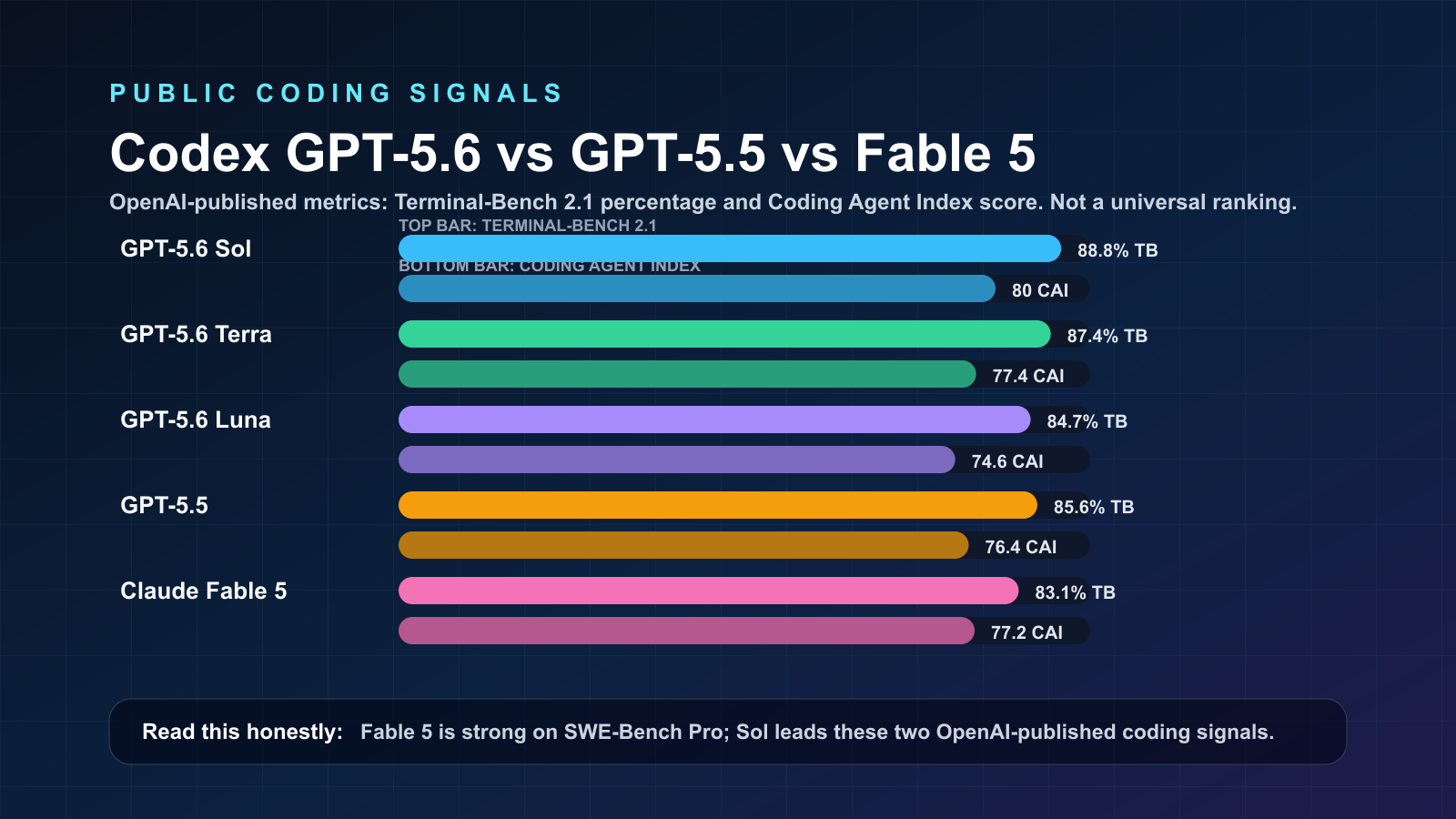
OpenAI's GPT-5.6 release gives a more apples-to-apples view for some coding metrics. In OpenAI's published table, GPT-5.6 Sol leads Claude Fable 5 on the Artificial Analysis Coding Agent Index and Terminal-Bench 2.1, while Claude Fable 5 leads on SWE-Bench Pro. That means the honest answer is not "one model wins everything." If you need repo-wide implementation, terminal workflows, speed, and Codex integration, GPT-5.6 Sol or Terra is usually the better starting point. If you are specifically benchmarking long-horizon code reasoning against SWE-Bench-style tasks, Fable 5 deserves a real test.
What This Means for Japanese Companies Using AI
For Japanese companies, the practical question is not which model has the best headline. The question is which model helps your team ship reliable software, protect customer data, improve SEO, automate operations, and reduce engineering bottlenecks. A Tokyo business building a Next.js site, mobile app, internal dashboard, or AI chatbot should test models against its own repo and documents.
The right AI workflow includes model choice, clear instructions, access boundaries, tests, staging deployment, human review, and production monitoring. A strong model without good process can still ship bad code. A slightly cheaper model with good tests and clear scope can be very productive.
Need Help Choosing an AI Coding Workflow?
If your company wants to use Codex, ChatGPT, Claude, or AI agents for software development, SEO, automation, or internal tools, contact IT Support in Tokyo. We can help design safe AI development workflows, evaluate models on your real codebase, and build Next.js, React, mobile, and cloud systems with proper review and deployment practices.