Cloudflare CEO: AI Agent Traffic Could Make Websites 1,000× More Expensive to Host
Key takeaways
Matthew Prince says bot traffic will reach 1,000× human traffic and a $3.17 site could cost over $3,000 to host. What he said, Cloudflare's data, and what to do.
Cloudflare's chief executive, Matthew Prince, says automated traffic from AI agents and crawlers will reach about 1,000 times human traffic within five years, and that the economics of running a website will not survive that unchanged. His example, repeated on the Big Technology Podcast in September and on Cloudflare's Q3 2026 earnings call on Nov 5, is a WordPress host whose site costs $3.17 to run and sells for $12.99. Scale the traffic 1,000 times and, in his words, it would cost "over $3,000" to host. Here is what Prince actually said, what Cloudflare has built in response, what Cloudflare's own data shows, and what a small company in Japan can do about it this month.
- The claim: automated traffic online will be about 1,000 times human traffic (Prince, Big Technology Podcast, Sep 2, 2026). He says the crossover, when bots overtook humans, came in May 2026.
- The example: one large WordPress host pays about $3.17 to host a site and charges about $12.99. At 1,000 times the traffic, Prince says, hosting it would cost over $3,000. The host is not named, and the figures are his illustration, not a forecast of any bill.
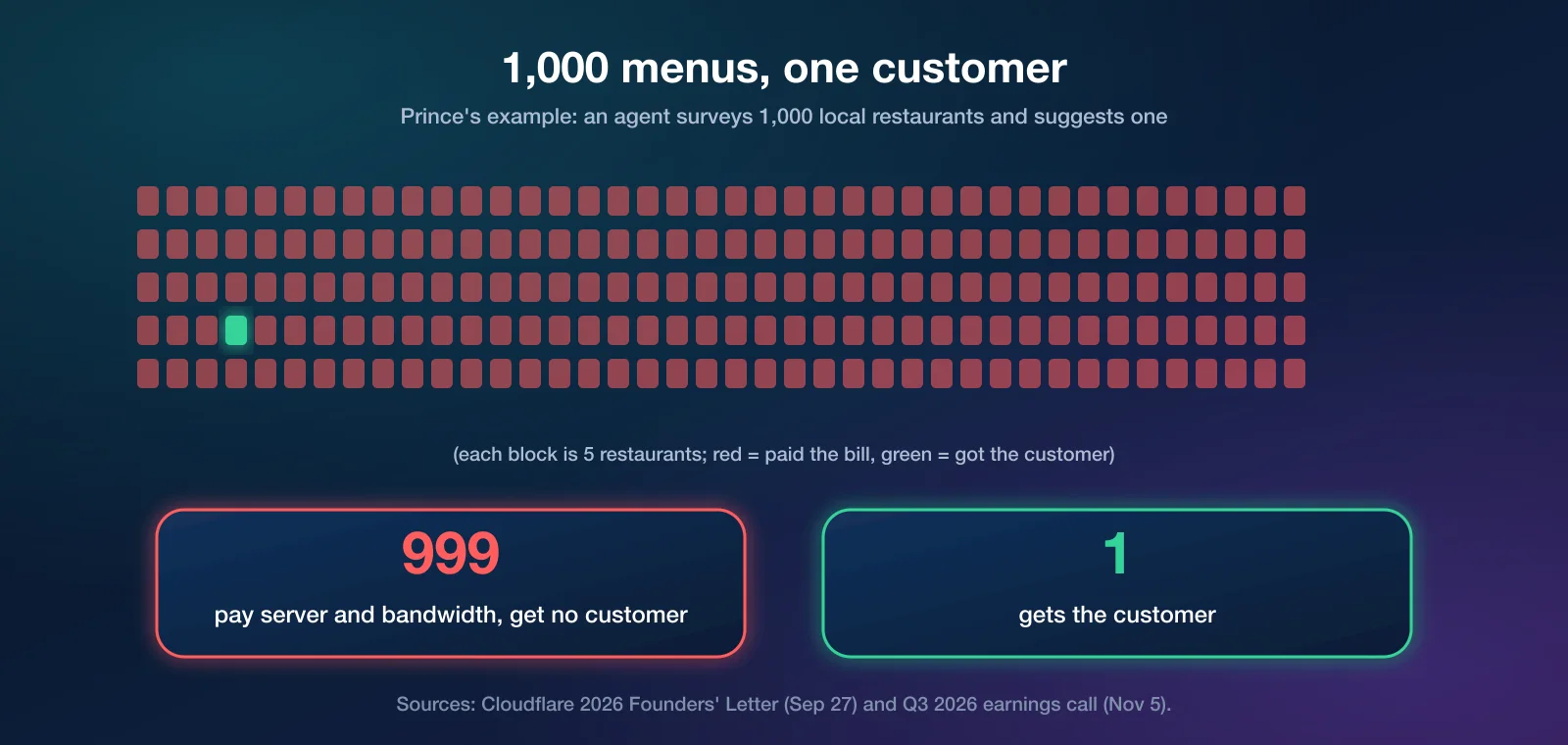
- The restaurant problem: an agent may read 1,000 restaurant menus to recommend one; the other 999 paid for the server time and got nothing (Cloudflare's 2026 Founders' Letter and the Q3 call).
- What Cloudflare sells against it: AI crawlers blocked by default and a Pay Per Crawl gateway (July 2025), a research pilot with OpenAI on page-change signals (July 2026), and a push toward serverless, cached architectures.

What Prince said, and where
The numbers come from Prince's own mouth on a podcast, not from a Cloudflare press release. On the Big Technology Podcast on Sep 2, 2026, he said automated traffic online "will be a thousand times what human traffic is", that one of the largest WordPress hosts "costs us about $3.17 to host a website" and "we charge like $12.99", and that at 1,000 times the traffic "it would cost us over $3,000 to host that website". He also said WordPress runs on PHP, "not the most efficient programming language", and that some fundamental web technologies have to change. He made the same argument on The Verge's Decoder podcast on Sep 26 and in Cloudflare's 2026 Founders' Letter on Sep 27, which is where the restaurant example appears: an agent "may survey 1,000 restaurant menus in the area only to suggest one". On the Q3 2026 earnings call on Nov 5, he put it as 999 of those restaurants now having a cost, as The Register reported.
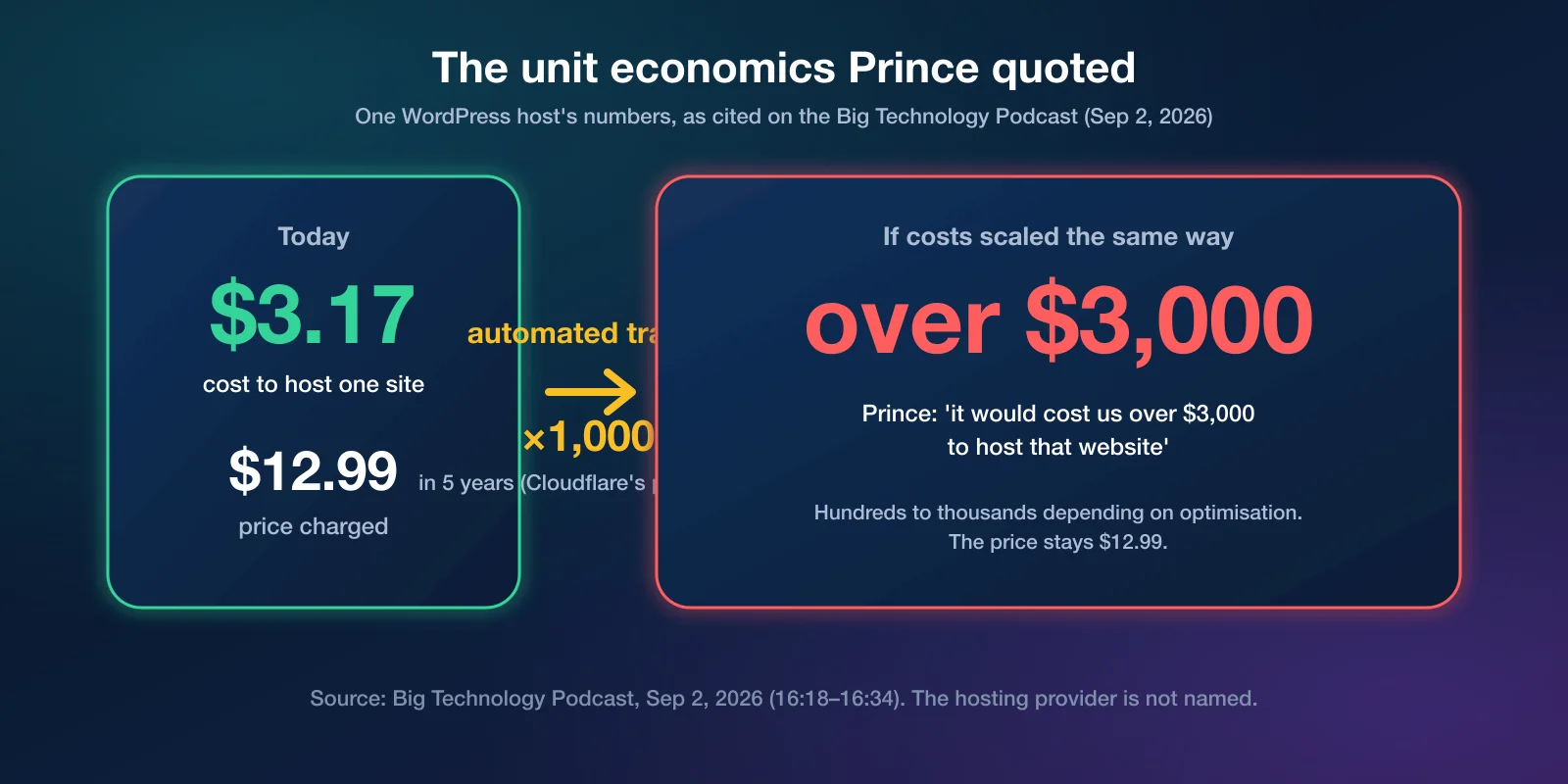
A caution on the arithmetic. The $3.17 figure is one provider's cost today; $3,000 is what Prince says it would become if cost scaled linearly with traffic. Real bills depend on caching, bandwidth pricing and how much of the extra traffic ever reaches the application server. Prince himself said the outcome would be "hundreds to thousands of dollars" depending on optimisation. Treat the 1,000 times figure as Cloudflare's projection and the $3,000 as a worked example, not a measurement.
What Cloudflare's own data shows
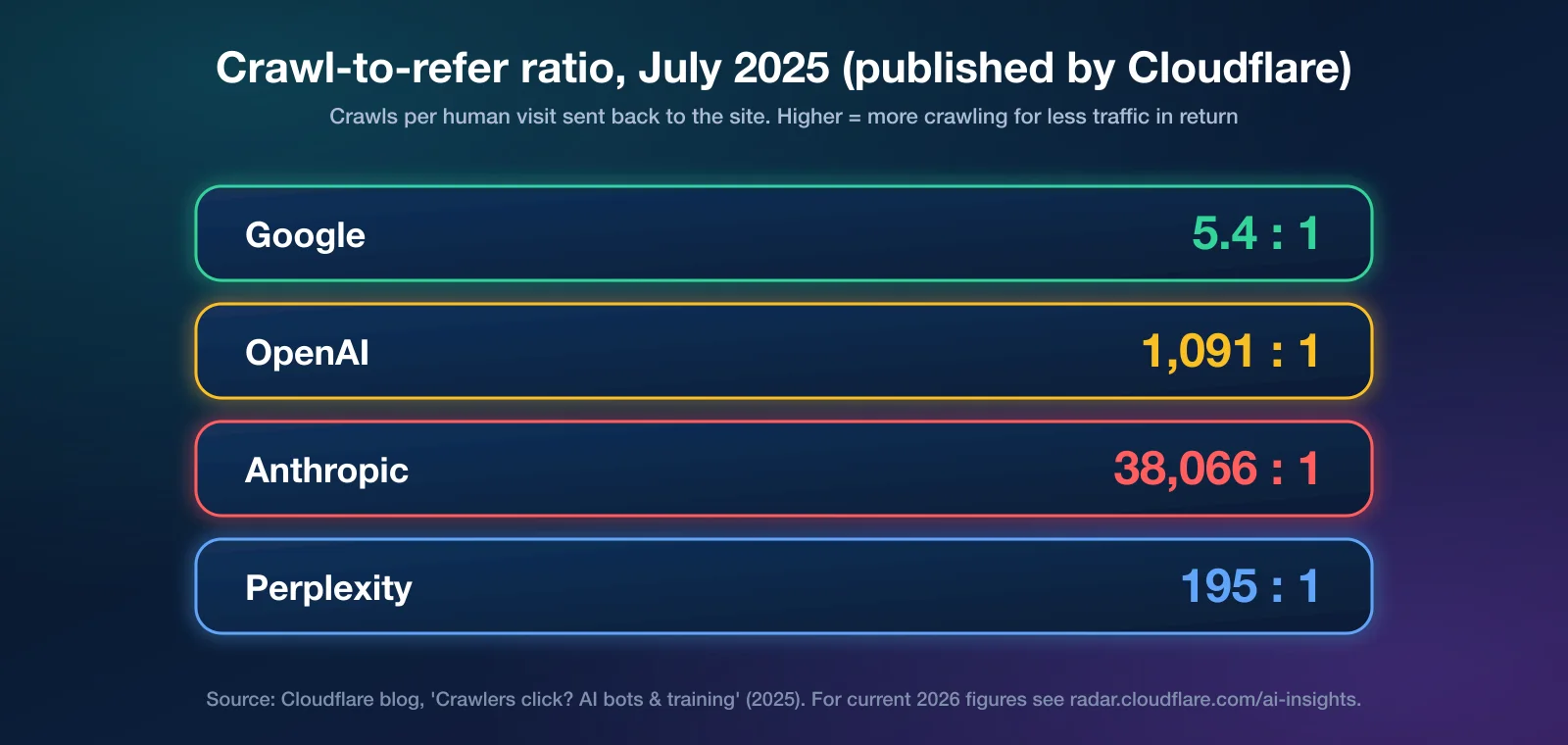
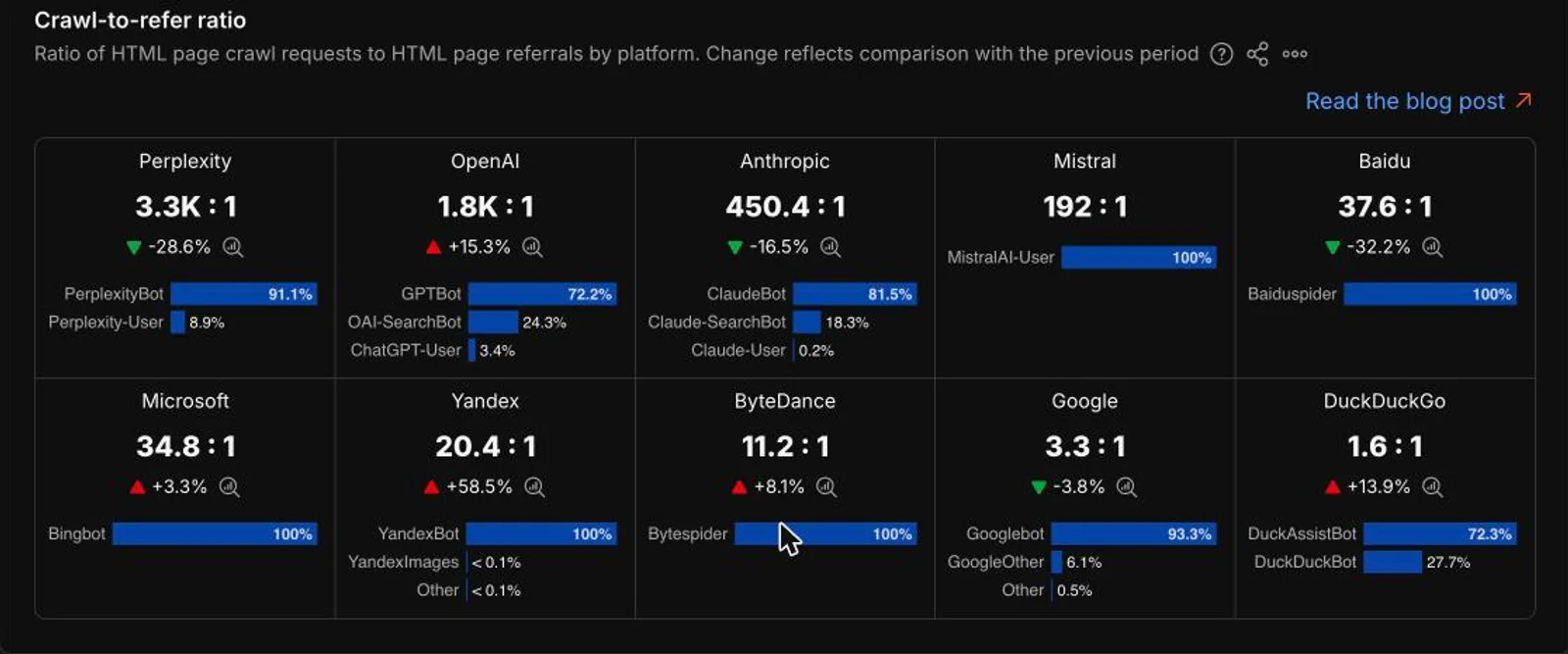
Cloudflare publishes crawler statistics on its Radar site. In July 2025 it reported "crawl-to-refer" ratios, the number of pages a platform crawls for every human visit it sends back, of about 5.4 for Google, 1,091 for OpenAI, 38,066 for Anthropic and 195 for Perplexity (Cloudflare blog). The ratio is the heart of Prince's argument: a search engine that crawls five pages and sends one visitor is a trade; a crawler that reads tens of thousands of pages per visitor is a cost. Current figures move week to week and are on Radar's AI Insights page.
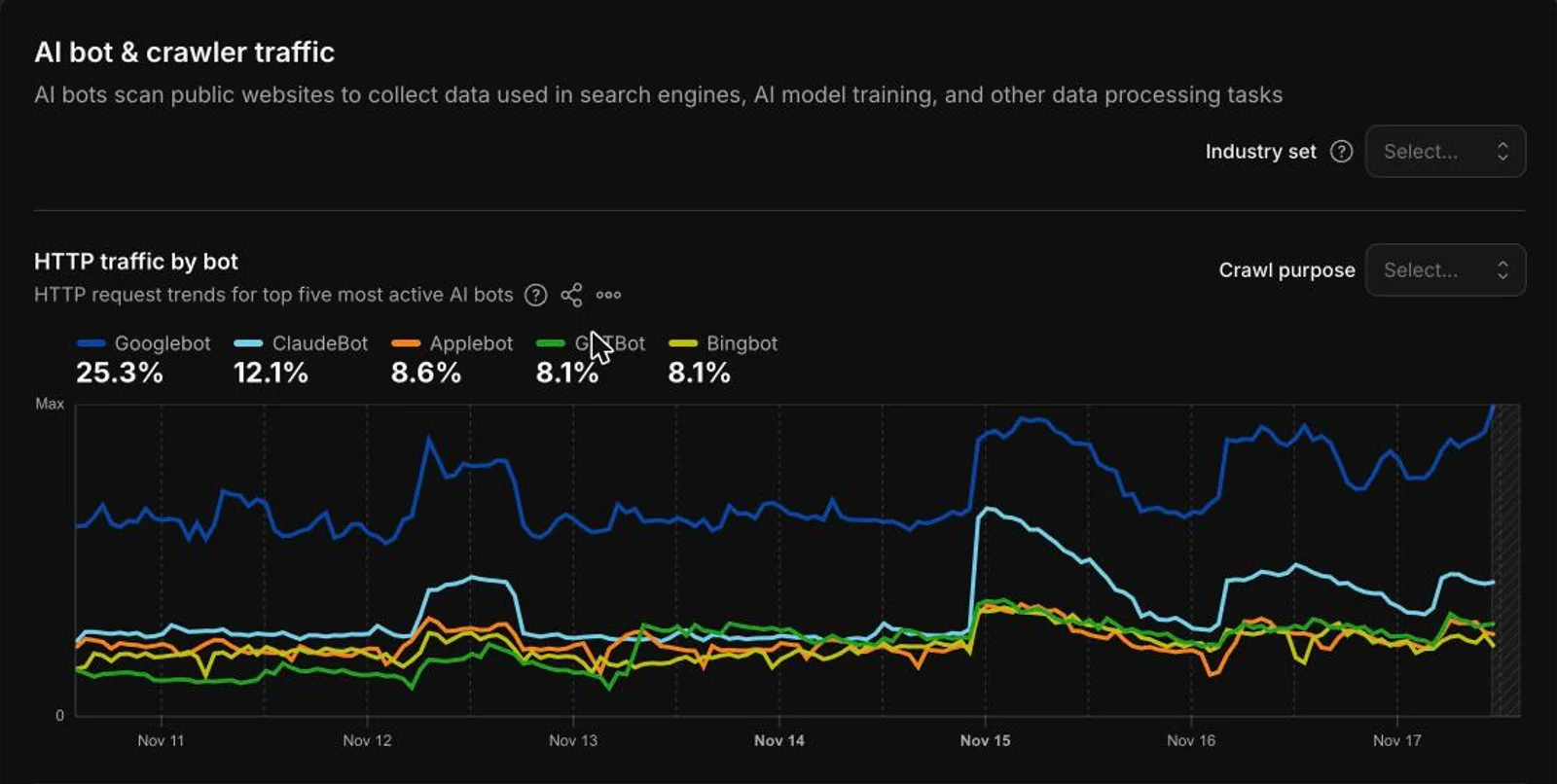
We looked at Radar on Nov 18, 2026. For the seven days to Nov 17, the five most active AI bots on Cloudflare's network were Googlebot (25.3% of the top-five's requests), ClaudeBot (12.1%), Applebot (8.6%), GPTBot (8.1%) and Bingbot (8.1%). That is Cloudflare's view of its own network, which carries a large share of the web but not all of it.
The same page gives the current crawl-to-refer ratios, which have shifted a long way since July 2025. For the seven days to Nov 17, 2026, Radar showed Perplexity at about 3,300 crawls per referral, OpenAI 1,800, Anthropic 450, Mistral 192, Baidu 37.6, Microsoft 34.8, Yandex 20.4, ByteDance 11.2, Google 3.3 and DuckDuckGo 1.6. Anthropic's ratio has fallen sharply from the 38,066 Cloudflare reported in 2025, while Perplexity's and OpenAI's have risen. Cloudflare notes that Radar counts HTML page requests only and that a referral is a visit that arrives with the platform as the referrer, so ratios for assistants that open links without a referrer are inflated.
What Cloudflare has built in response
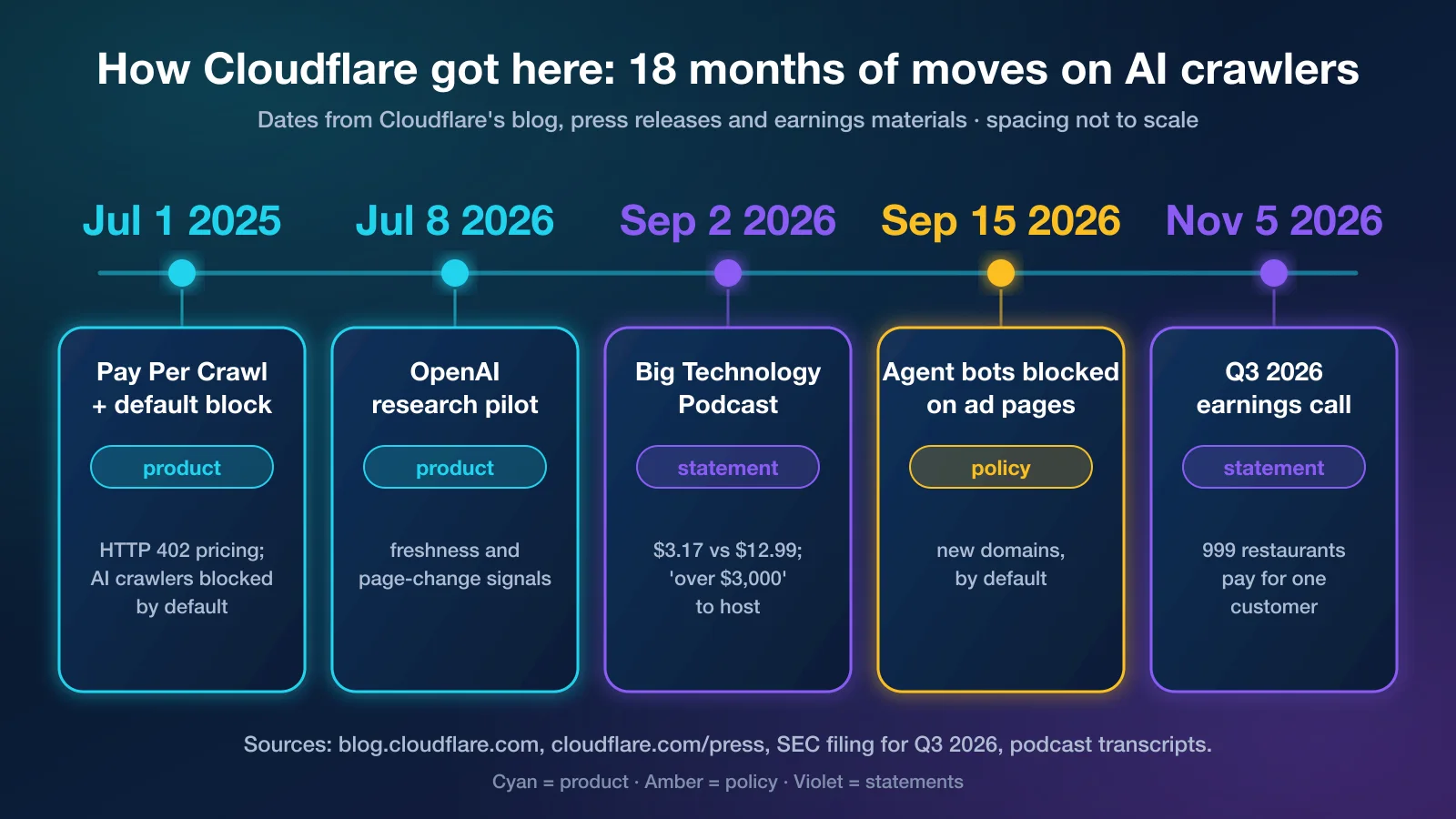
- Default blocking of AI crawlers (Jul 1, 2025). New Cloudflare domains block AI training crawlers unless the owner opts in (announcement). From Sep 15, 2026, training and agent bots are also blocked by default on pages that carry ads for new domains (update).
- Pay Per Crawl (Jul 1, 2025, private beta). A site can answer a crawler with an HTTP 402 "Payment Required" response that states a price; Cloudflare acts as merchant of record and settles the micropayments (announcement). The pasted summaries circulating online call this a "monetization gateway", which is a fair description.
- Page-change signals with OpenAI (Jul 8, 2026). Cloudflare announced a research pilot with OpenAI on "content freshness, traffic quality, and actual page changes" (press release). In October it reported results: change signals tell a crawler when a page is worth another visit, tested on about 1% of Cloudflare's network (blog).
- Serverless and caching. Prince argues that container-based servers cannot keep up cost-effectively and that lighter runtimes such as Cloudflare Workers, plus aggressive static caching, are the fix. Cloudflare sells those products, so weigh the argument accordingly.
What this means for a small company in Japan
Most Japanese small-business websites run on shared WordPress hosting or a page builder, often on a plan with a bandwidth cap. Those are the sites Prince's example describes. The practical questions are not about 2031; they are about whether your hosting bill or your page speed has already moved. A restaurant, clinic or shop whose menu, prices and opening hours are read by agents on behalf of customers is exactly the case he describes, and the honest answer is that you want agents to read those pages, cheaply, and you want the cost to be yours to control.
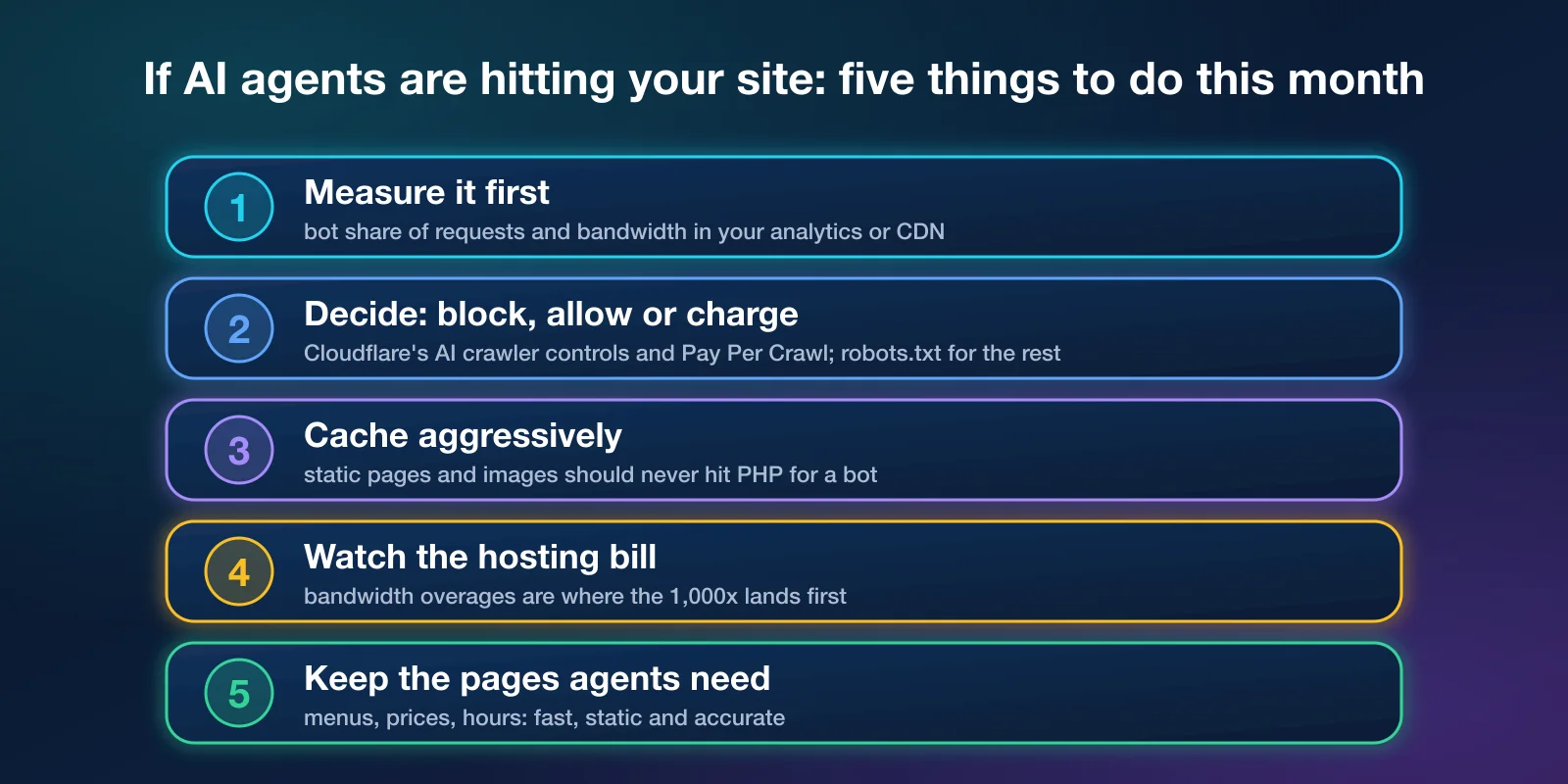
- Measure it first. Your analytics, server logs or CDN dashboard will show what share of requests and bandwidth is automated. Decide on numbers, not headlines.
- Decide: block, allow or charge. If you are on Cloudflare, the AI crawler controls and Pay Per Crawl are a few clicks. Everyone else has robots.txt, which well-behaved crawlers honour and bad ones ignore.
- Cache aggressively. A static page or image should be served from a cache, never by PHP, when a bot asks for it. This is the single biggest lever on the $3.17.
- Watch the hosting bill. Bandwidth overage is where extra automated traffic shows up first on shared plans.
- Keep the pages agents need. Menus, prices and hours should stay fast, static and accurate. Blocking agents from the page that wins you the booking is self-harm.
Want to know what AI crawlers are costing your site?
We measure bot traffic, set crawler rules and move heavy WordPress sites to cached, static builds for Tokyo businesses, in English and Japanese. Book a free consultation.
Sources
Big Technology Podcast, "Cloudflare CEO: We're ready to block millions of websites from AI", Sep 2, 2026 (transcript); The Verge, Decoder with Matthew Prince, Sep 26, 2026 (episode); Cloudflare, 2026 Annual Founders' Letter, Sep 27, 2026; Cloudflare Q3 2026 results, Nov 5, 2026 (SEC exhibit; call transcript); The Register, report on the call, Nov 6, 2026; Cloudflare blog posts on Pay Per Crawl and default blocking (Jul 1, 2025), ad-page blocking (Jul 1, 2026), crawl-to-refer ratios (2025) and the OpenAI pilot results (Oct 15, 2026); Cloudflare press release on the OpenAI pilot, Jul 8, 2026; Cloudflare Radar, AI Insights, viewed Nov 18, 2026. Graphics are our own. The Radar chart is our screenshot of Cloudflare's public page, © Cloudflare, Inc. The photo-style image was generated with ChatGPT and is not a photograph of a real company. IT Support in Tokyo is not affiliated with Cloudflare, OpenAI or WordPress.
Related: More tech news · Is WordPress safe after PHP2shell? · Migrating WordPress to Next.js