GMO Desktop Cloud Breach: Trader Data Posted Online, ¥8 Billion Demanded (Oct–Nov 2026)
Key takeaways
GMO Internet shut its trading-desktop service after malware, got an ¥8bn ransom demand, and confirmed stolen data was posted. What GMO said, report by report, and what to do.
GMO Internet, one of Japan's largest internet companies, shut down its "Onamae.com Desktop Cloud" virtual-desktop service on Oct 21, 2026 after finding malware on it, received a threatening email demanding about 8 billion yen the same day, and on Oct 27 confirmed that data allegedly taken from the service had been published online. The service is used by retail forex and stock traders to run trading tools around the clock, and GMO says login details saved in those tools may have been taken and misused. By Nov 6 the company had issued sixteen incident reports and begun contacting customers about compensation for unauthorised trades. Here is what GMO itself has said, in order, and what a Japanese business or trader should do.
- Service: Onamae.com Desktop Cloud, a Windows virtual desktop sold by GMO Internet, Inc. (GMO Internet Group), widely used for automated forex and stock trading.
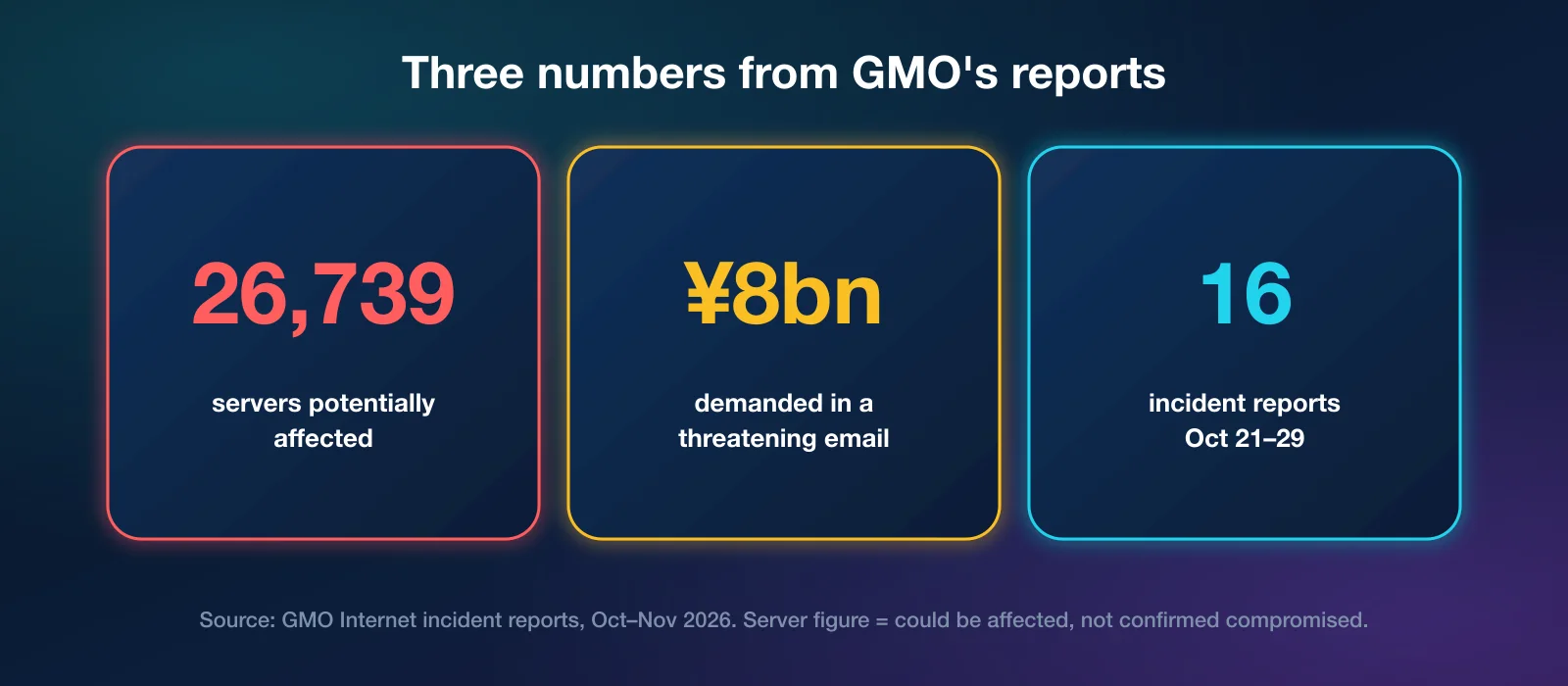
- Scale: 26,739 servers potentially affected, per GMO. That is the number that could be affected, not the number confirmed compromised.
- Timeline: malware confirmed Oct 20; service shut down and first report published at 04:00 JST on Oct 21; threatening email demanding about ¥8 billion received Oct 21; police consulted Oct 22; publication of data confirmed at 12:30 JST on Oct 27; individual contact about compensation began Nov 6.
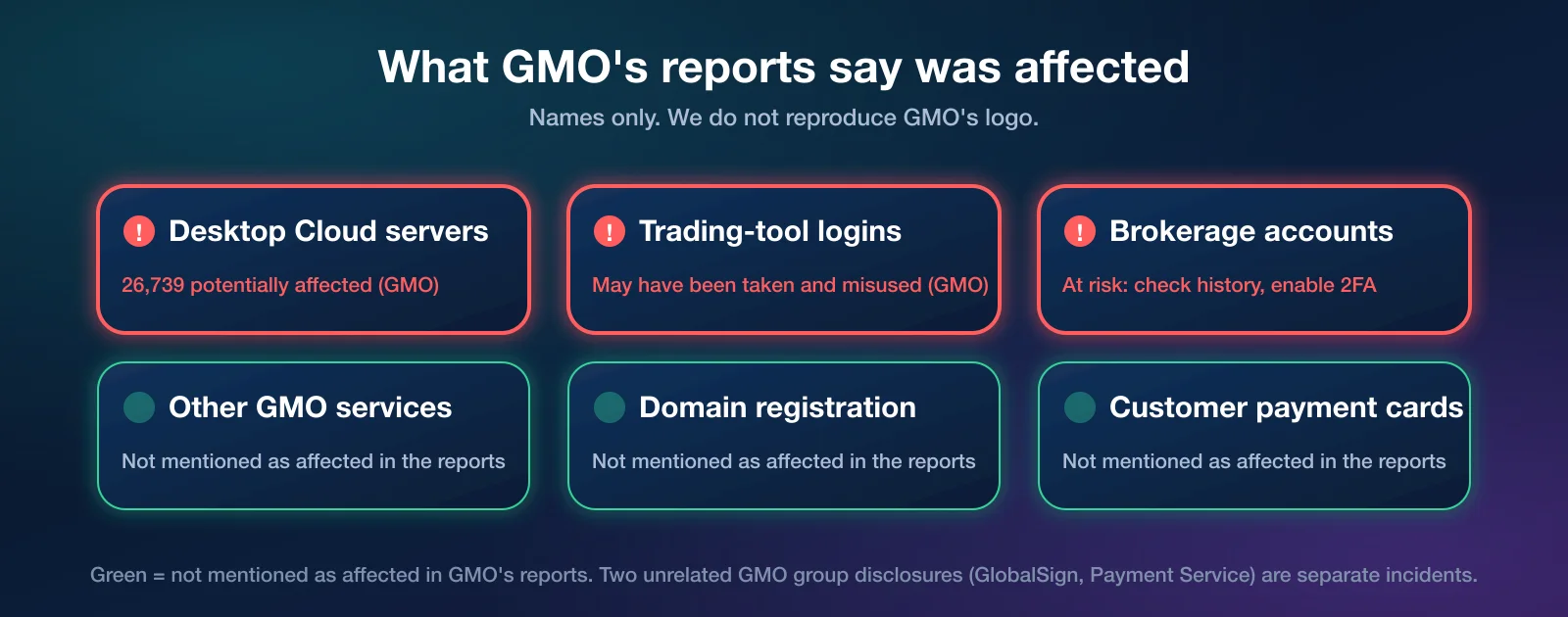
- What was taken: GMO says data saved on the servers, including trading-account login details stored in trading tools, may have been obtained and used without authorisation. The posted material may be partly false, GMO says, and it is verifying it.
- Ransom: GMO recorded the ¥8 billion demand in its timeline. As of its Oct 27 report, a ransomware attack had been threatened but not confirmed.
What the service is, and why traders use it
Onamae.com Desktop Cloud is a Windows desktop running in GMO's data centre that a customer controls remotely. Its main market is individual traders who need a PC that never sleeps: automated forex or stock trading tools run on it 24 hours a day, logged in to the customer's brokerage account. That design is why this breach matters more than a typical hosting incident. A trading tool running on a compromised server has the customer's account credentials inside it, and GMO's own reports say exactly that.
What GMO has said, report by report
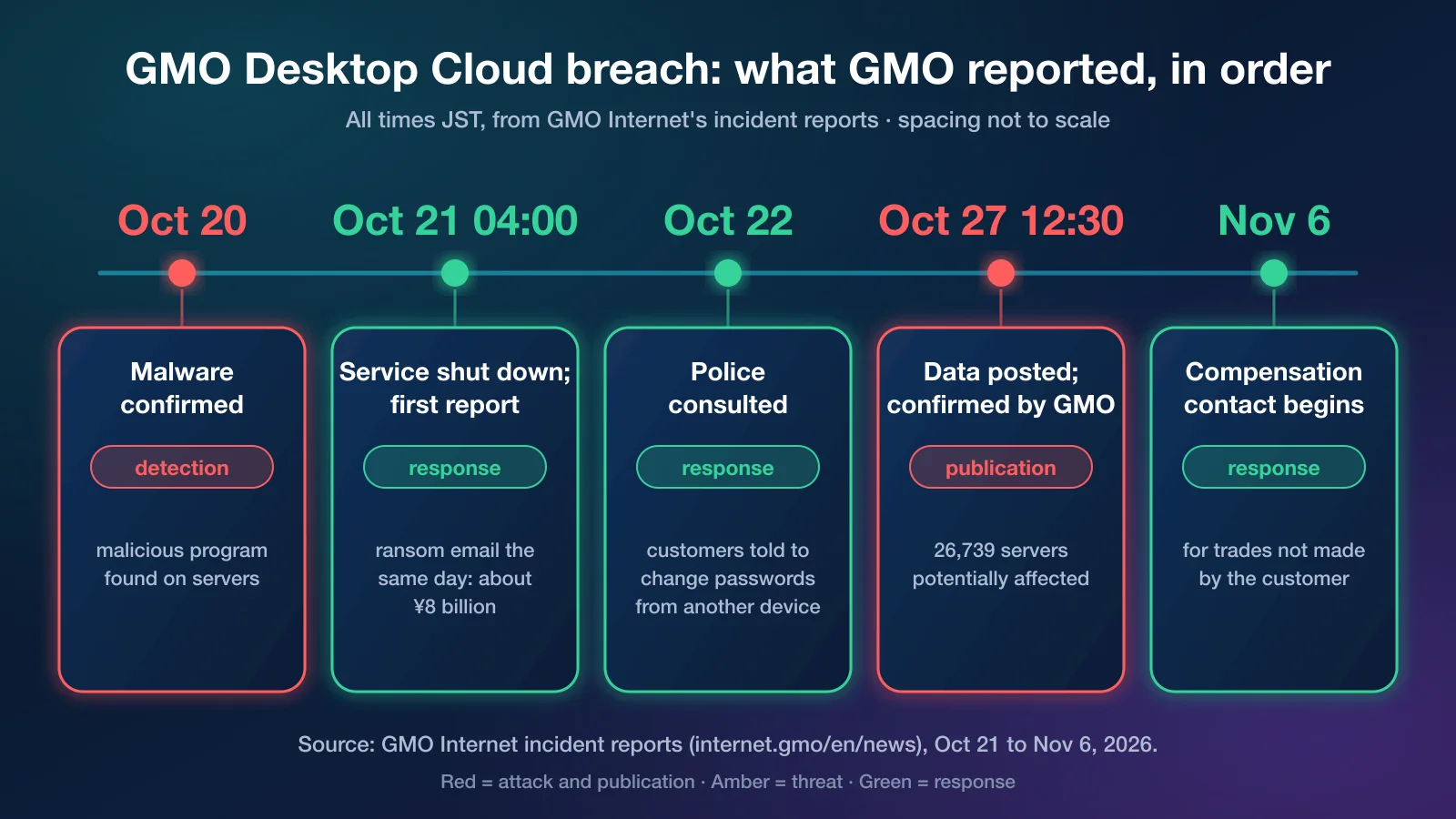
GMO has published its incident reports in Japanese and English on its news page (English, Japanese). The key ones:
- Oct 21, 04:00 JST, first report: GMO announces unauthorised access by a third party, apologises, and shuts the service down. It later says it had confirmed a malicious program on the servers on Oct 20.
- Oct 22, second report: GMO tells customers to change trading-tool and account passwords from a device other than the Desktop Cloud server, check their transaction history, and turn on two-factor authentication where their broker offers it. The timeline records a threatening email on Oct 21 demanding approximately 8 billion yen, and a consultation with police on Oct 22.
- Oct 24, fourth report: GMO sets out a compensation framework for losses from transactions "not made by customers' own will", which it later refers back to.
- Oct 26, seventh report: GMO begins collecting affected devices for investigation and adds advice: run a full antivirus scan, keep backups, and disconnect and power off affected PCs.
- Oct 27, 13:55 JST, tenth report (日本語): GMO confirms that at 12:30 JST a party posted information allegedly linked to customers and its business. It says the content may be partly false, that it is verifying it, that it will contact affected customers individually, and that customers should not access the site where it was posted. It puts the number of potentially affected servers at 26,739. It says a ransomware attack has been threatened but not confirmed.
- Oct 27, twelfth report: a special condolence payment for customers whose information was published.
- Nov 6, notice to customers: GMO begins contacting customers individually about compensation for losses from unauthorised transactions in their trading accounts, and publishes a status update on compensation on its investor-relations site. It repeats that customers should not access suspicious sites or repost published content.
What the press has added, and what it has not
TechCrunch reported the publication of the data on Oct 27, describing the service as one used by financial traders and putting the number of affected servers at about 27,000; GMO's own figure is 26,739. TechCrunch's "about $50 million" is its conversion of the ¥8 billion demand. No group has been publicly named as responsible in GMO's reports or in TechCrunch's story, and GMO's reports do not say how the attackers got in. Nikkei xTECH Active reported on Nov 16 that GMO Internet Group expects an impact of about ¥3.05 billion on its October–December results from the incident and is running an emergency security inspection across the group. We could not find that figure in GMO's own releases, so we attribute it to Nikkei.
Three other GMO incidents in the same fortnight
Two unrelated disclosures from other GMO group companies landed in the same news cycle and are easy to confuse with this one. On Nov 2, GMO GlobalSign said a configuration error had left about 45,000 people's names and email addresses at 2,492 corporate customers of an identity-management service viewable from outside for about nine years; it said passwords and payment data were not included, per Jiji Press. On Nov 5, GMO Payment Service said up to 106,997 records had been exposed through unauthorised access at a contractor. Neither involves Desktop Cloud, and we have not verified them beyond the reports linked.
If you run trading tools on a hosted desktop
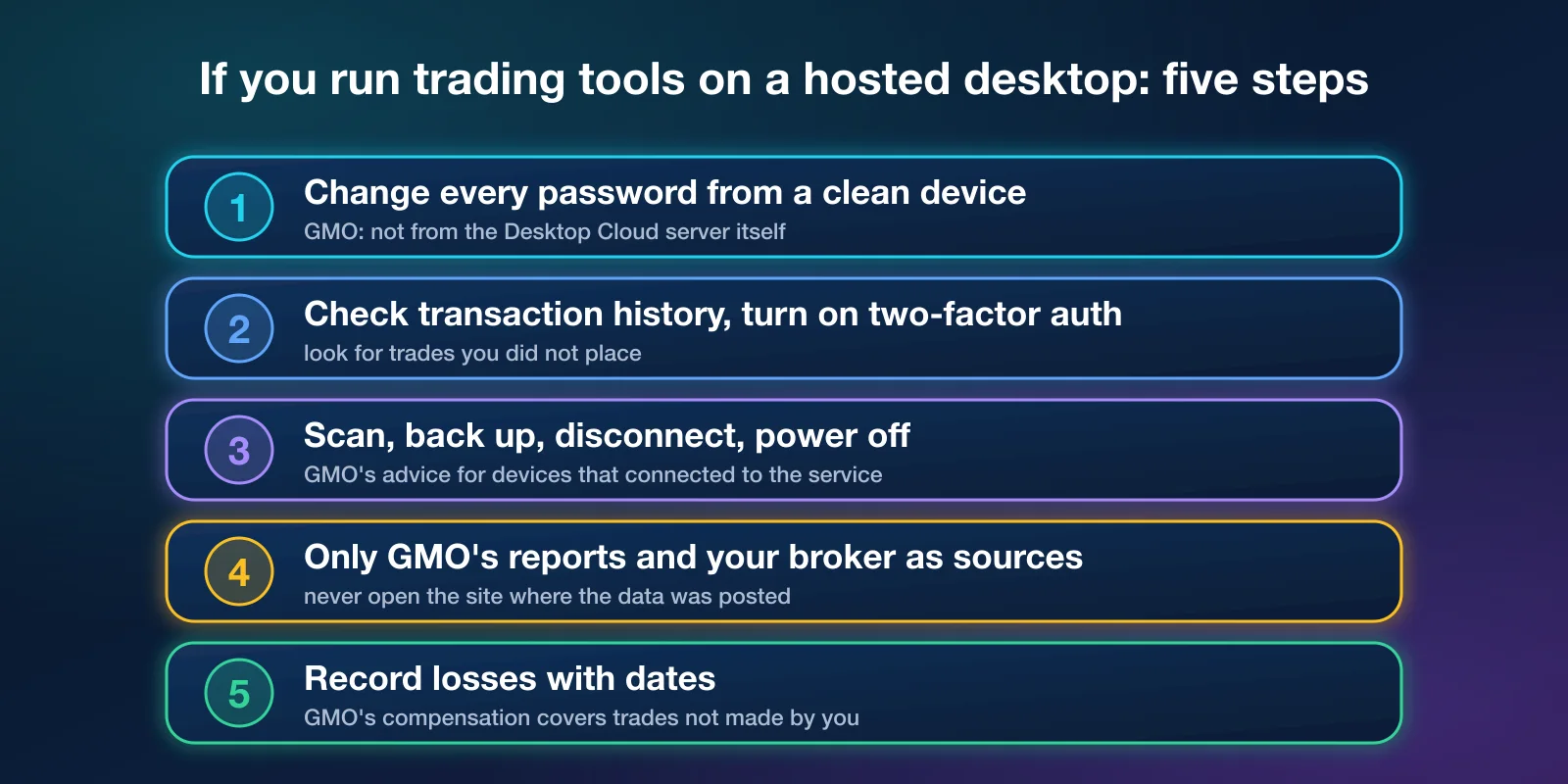
- Change every password from a clean device. GMO's advice is to change trading-tool and account passwords from a machine other than the Desktop Cloud server. A password changed on the compromised machine can be captured again.
- Check your transaction history and switch on two-factor authentication. Look for trades you did not place. Most Japanese brokers offer app-based or SMS second factors; GMO tells customers to enable them where available.
- Scan, back up, disconnect, power off. GMO's later reports ask customers to run a full antivirus scan on devices that connected to the service, keep backups, and disconnect and power off affected PCs.
- Use only GMO's reports and your broker as sources. Do not visit the site where the data was posted, and do not repost it. GMO says it will contact affected customers individually.
- Record losses with dates. GMO's compensation framework covers losses from transactions not made by the customer's own will. Screenshots and statements with timestamps will make the claim straightforward.
Need help securing a trading setup or a small company's remote desktops?
We help Tokyo businesses and individual traders move automated tools to isolated machines, set up two-factor authentication and password rotation, and write a short incident plan, in English and Japanese. Book a free consultation.
Sources
GMO Internet, Inc. incident reports on Onamae.com Desktop Cloud, Oct 21 to Nov 6, 2026, including the first report, second report, seventh report, tenth report (Japanese), twelfth report and Nov 6 notice, all listed at internet.gmo/en/news; GMO Internet Group IR, compensation status, Nov 6, 2026; TechCrunch, Kate Park, "Japan internet giant GMO says hackers posted stolen customer data", Oct 27, 2026; Nikkei xTECH Active, report on the financial impact, Nov 16, 2026; Jiji Press on the GlobalSign disclosure, Nov 2, 2026. Graphics are our own and use names only. The photo-style image was generated with ChatGPT and is not a photograph of any customer or GMO facility. IT Support in Tokyo is not affiliated with GMO Internet Group. Onamae.com is a trademark of GMO Internet, Inc.
Related: More tech news · Securing API keys and tokens · IT support in Tokyo