newmo Raises ¥20.8 Billion Series B Led by KDDI for Japan Robotaxis (Nov 2026)
Key takeaways
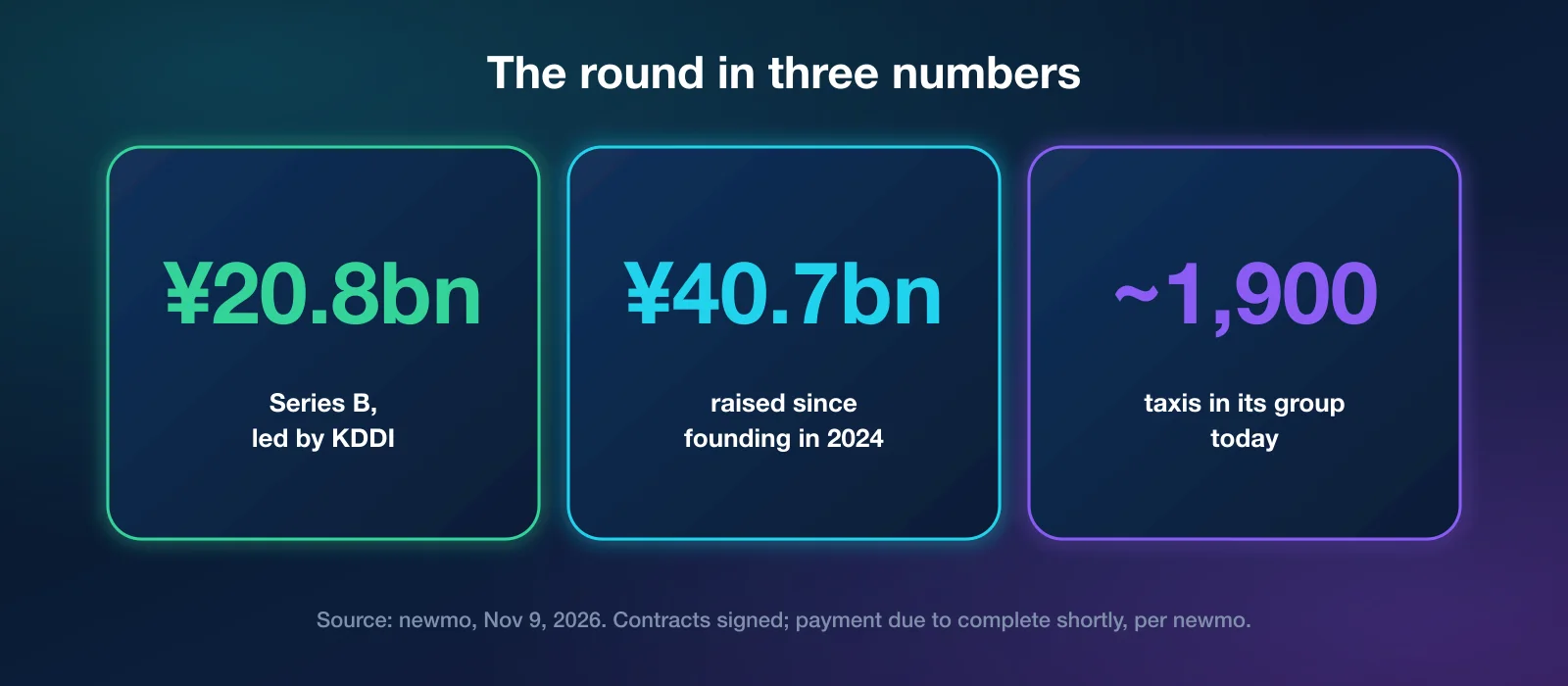
Tokyo startup newmo, which runs about 1,900 taxis, is raising ¥20.8bn led by KDDI (total ¥40.7bn) to grow nationwide and launch robotaxis in Sakai in 2028.
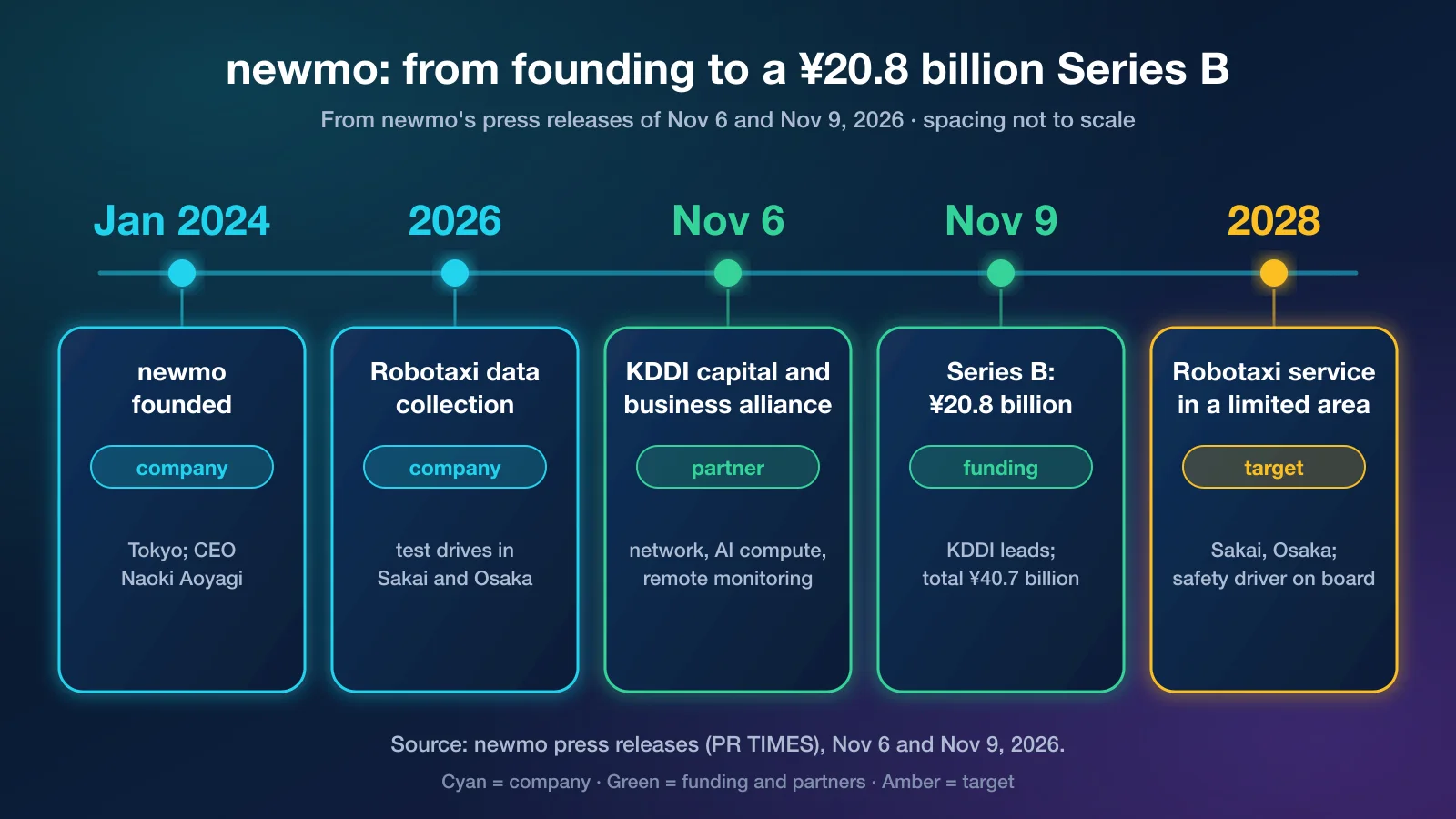
newmo, a Tokyo mobility startup that runs about 1,900 taxis and is building its own self-driving AI, said on Nov 9, 2026 that it is raising ¥20.8 billion (about $135 million) in a Series B round led by KDDI. The round takes newmo's total funding to ¥40.7 billion less than three years after it was founded. Three days earlier, newmo, KDDI and KDDI Smart Mobility announced a capital and business alliance aimed at commercial robotaxi service in Sakai, Osaka in 2028. Here is what the companies announced, where the money goes, and what it says about building a startup in Japan.
- Round: Series B, ¥20.8 billion by third-party allotment of new shares. KDDI is the lead investor. Contracts are signed and payment is due to complete shortly, newmo says.
- Total raised: ¥40.7 billion since founding in January 2024.
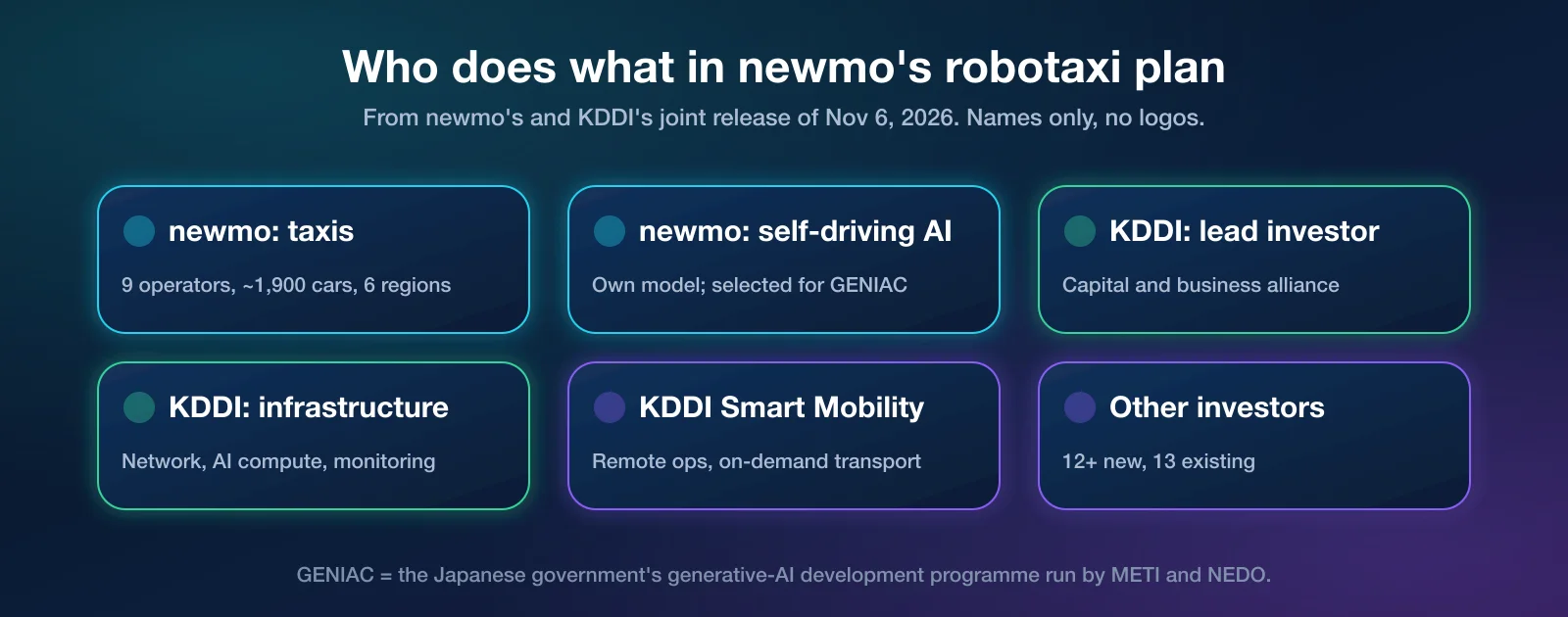
- Business today: nine taxi operators in the group, about 1,900 taxis, more than 2,800 employees, in Osaka, Kanagawa, Tokyo, Okinawa, Hokkaido and Aichi.
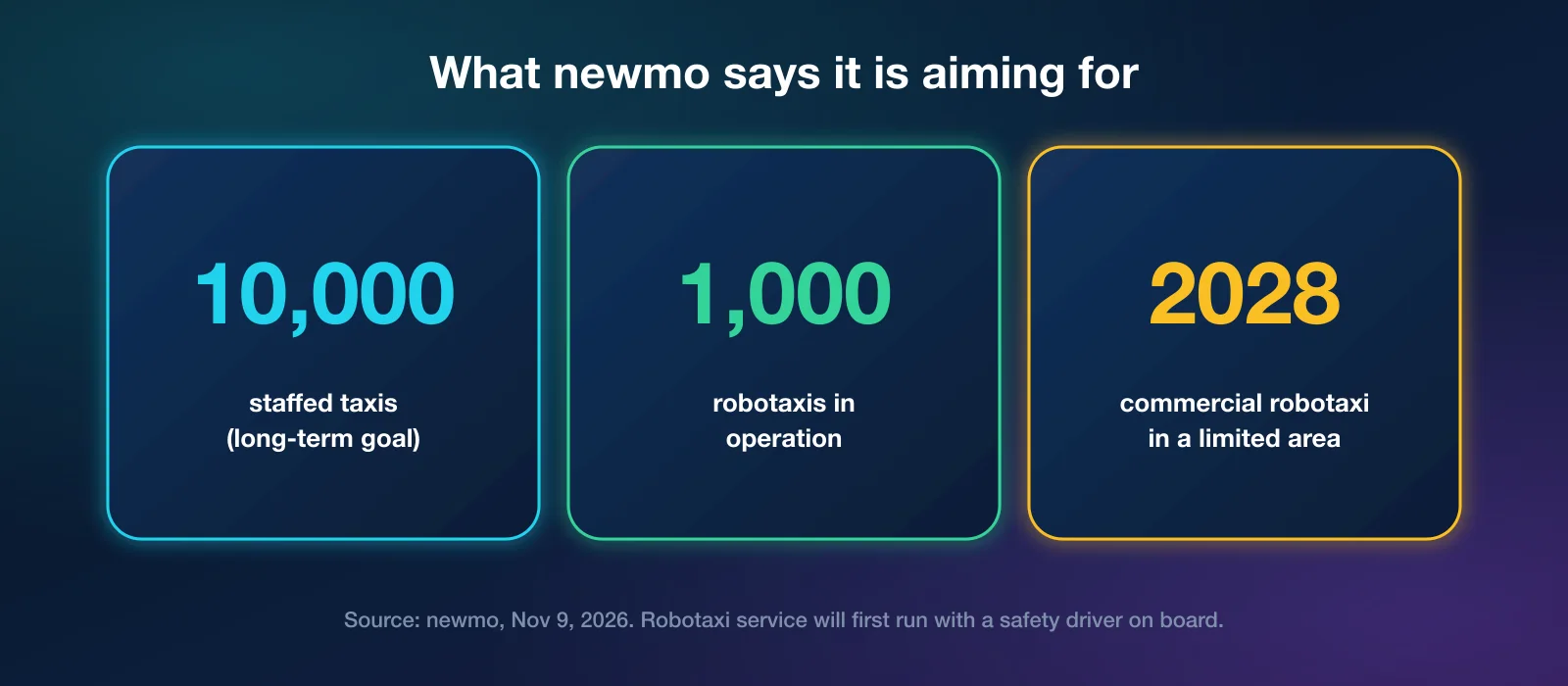
- Targets: commercial robotaxi service in a limited area in 2028 (with a safety driver on board at first), 1,000 robotaxis in operation over time, and 10,000 staffed taxis as a long-term goal.
- Partner: KDDI provides network, AI compute, remote monitoring and high-precision positioning under the Nov 6 alliance.
What newmo announced
In its Nov 9 press release, newmo says the money will be used for two things at once. The first is growing its taxi business: expanding in existing areas, opening new ones starting with Fukuoka (announced in October 2026), and adding cars through new companies and business succession. The second is speeding up its robotaxi work, with commercial service in a limited area in 2028 and a gradual increase to around 1,000 robotaxis on top of its own taxi operations.
newmo describes itself as the only company in Japan that vertically integrates a nationwide taxi business with self-developed self-driving AI. Its driving model has been trained on data from test drives in Sakai and Osaka since 2026, and was selected for GENIAC, the generative-AI development programme run by Japan's Ministry of Economy, Trade and Industry (METI) and NEDO. newmo also runs the secretariat of the Sakai City robotaxi consortium.
Timeline
Why KDDI matters more than the money
The Nov 6 joint release sets out who does what. KDDI will provide an optimised network linking vehicles to a remote-monitoring centre, AI compute for training and running the driving model, remote monitoring for safe operation, and high-precision positioning. newmo has already been training its model on KDDI's AI compute. KDDI Smart Mobility brings experience running AI on-demand transport and self-driving buses, and the three companies will look at offering the dispatch, operations and remote-monitoring functions developed in Sakai to regional transport operators across Japan.
The background is a national one. Japan faces a shortage of drivers as the population ages, and bus routes are being cut. The government's transport policy plan aims for 10,000 self-driving service vehicles, such as buses and taxis, across Japan by fiscal 2030 (MLIT, Third Basic Plan on Transport Policy). A company that already operates taxis, employs drivers and holds the licences is in a strong position to put robotaxis on the road when the rules allow.
Who invested
KDDI leads. New investors named by newmo include BRICKS FUND TOKYO by Mitsubishi Estate, DG Daiwa Ventures, the SMBC-GB Growth Fund, the Mori Building Innovation Fund, Yokohama Capital and two taxi operators, Kokusai Motorcars (国際自動車) and Daiwa Motor Transportation (大和自動車交通), among others. Existing investors who joined again include ANRI, Eight Roads Ventures Japan, Globis Capital Partners, GMO VenturePartners, JAFCO, SBI Investment, Global Brain, Keio Innovation Initiative and Mercari. BRIDGE and other Japanese startup media reported the round on Nov 9.
What founders in Japan can take from it
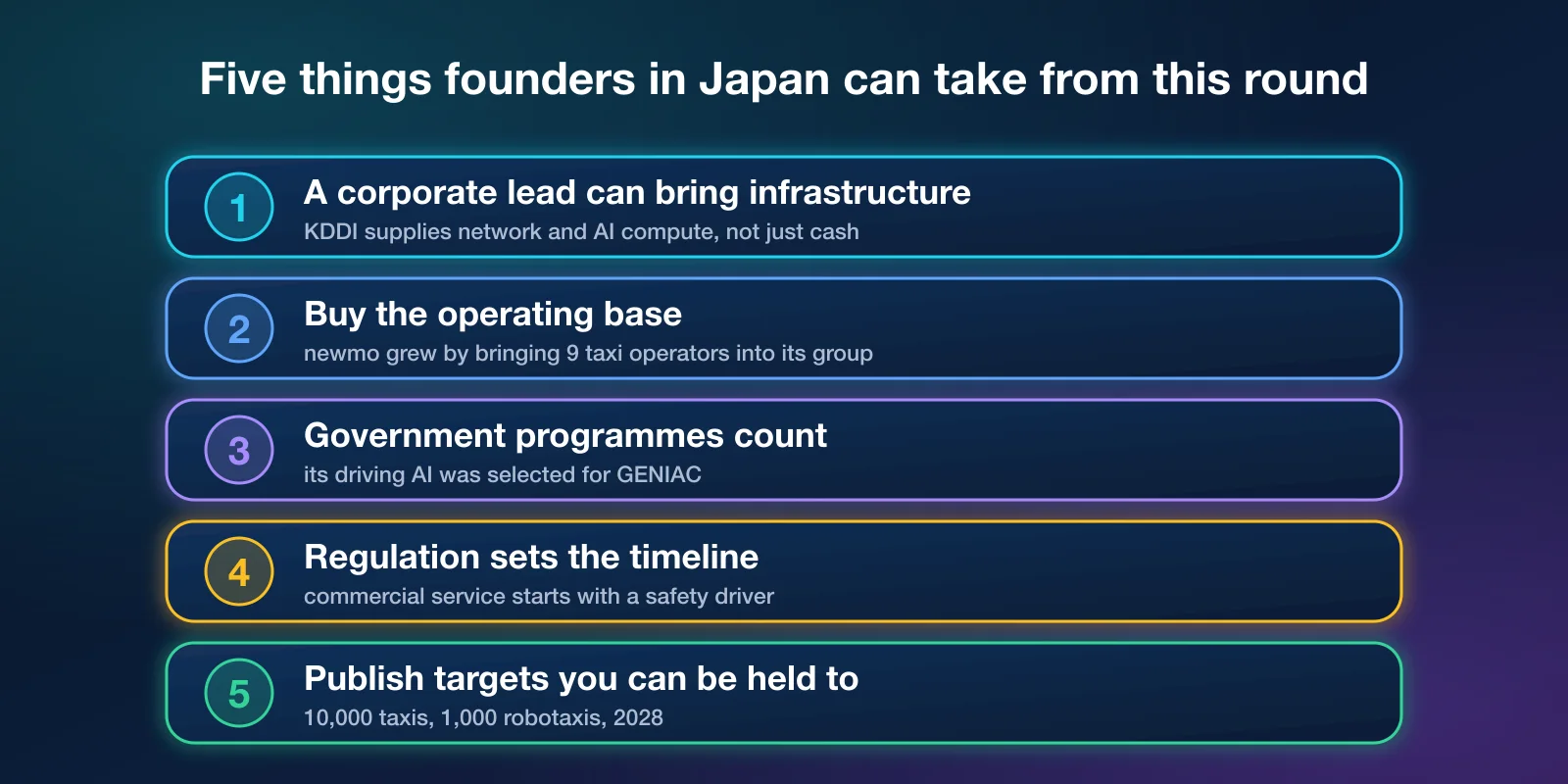
- A corporate lead can bring infrastructure, not just cash. KDDI's network, AI compute and monitoring are core inputs for a robotaxi service. For a deep-tech startup in Japan, the right strategic investor can be worth more than a higher valuation.
- Buy the operating base. newmo grew to nine taxi operators in under three years. In regulated industries, acquiring licensed operators can be faster than building from zero.
- Government programmes count. Selection for GENIAC supports newmo's AI development and signals credibility to investors.
- Regulation sets the timeline. Commercial robotaxi service in 2028 will start with a safety driver on board. Plan your product around what is allowed, not what is technically possible.
- Publish targets you can be held to. 10,000 taxis, 1,000 robotaxis, 2028. Clear, checkable goals make a round easier to explain to staff, partners and the next investors.
Building a startup or a new service in Japan?
We build the web apps, booking systems and dashboards that early-stage companies need, and keep them running, in English and Japanese. Book a free consultation.
Sources
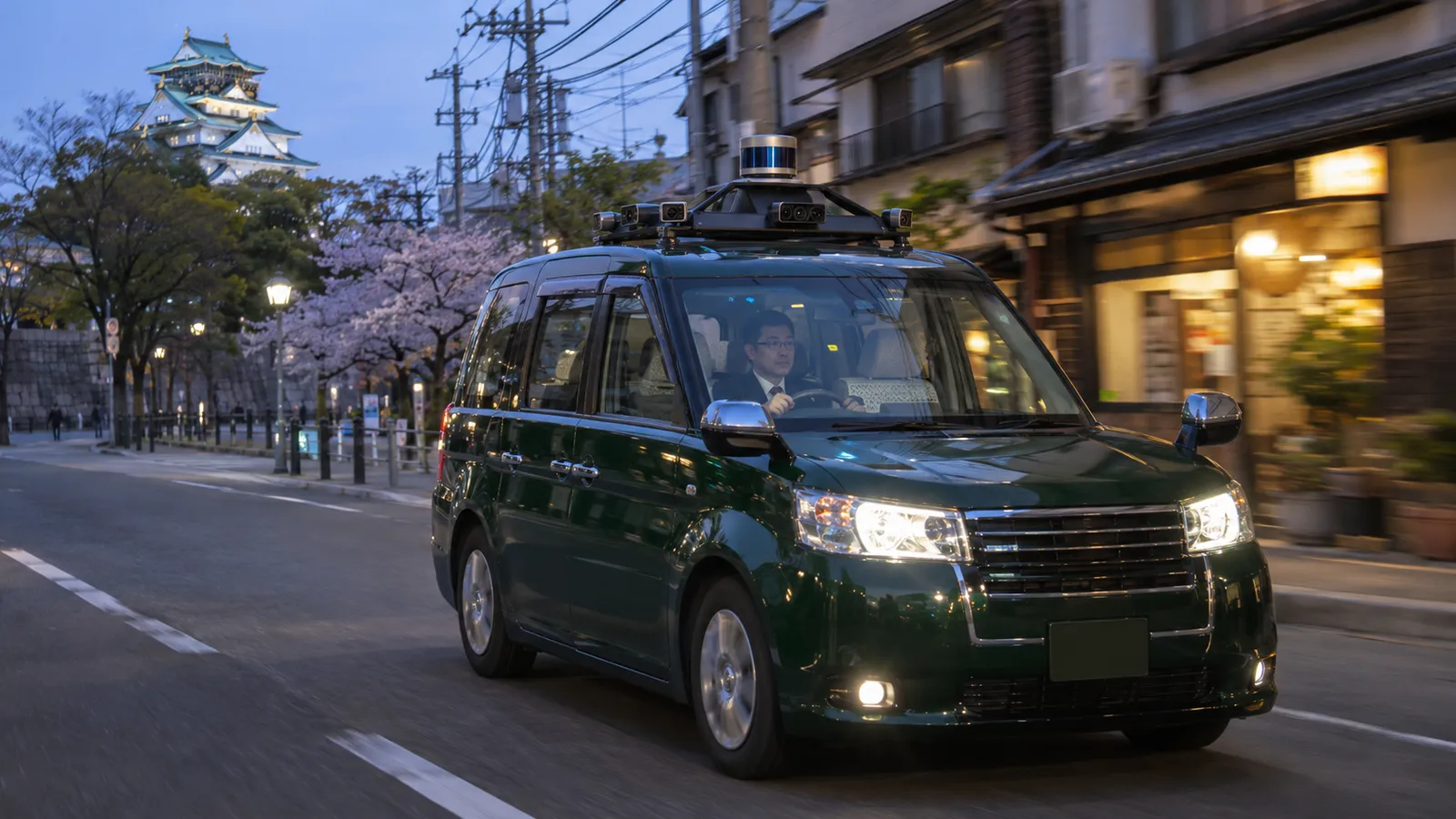
newmo, "newmo raises ¥20.8 billion in Series B round" (Japanese), Nov 9, 2026; newmo, KDDI and KDDI Smart Mobility, "newmo and KDDI form capital and business alliance for robotaxi deployment" (Japanese), Nov 6, 2026; newmo news page; Ministry of Land, Infrastructure, Transport and Tourism, Third Basic Plan on Transport Policy; BRIDGE, report of Nov 9, 2026. The dollar figure is our approximate conversion. Graphics are our own and use names only. The photo-style image was generated with ChatGPT and is not a photograph of newmo's vehicles. IT Support in Tokyo is not affiliated with newmo or KDDI.
Related: More tech news · Cloudflare CEO on AI agent traffic · App development in Tokyo