What Is Gemini Hydrogen? Every Gemini 4 Model Compared (Nov 2026)
Key takeaways
Gemini Hydrogen is Gemini 4 Hydrogen, Google's fast everyday model released Nov 12, 2026. Hydrogen vs Neon vs Carbon vs Argon: specs, API pricing, Japan plans and which to use.
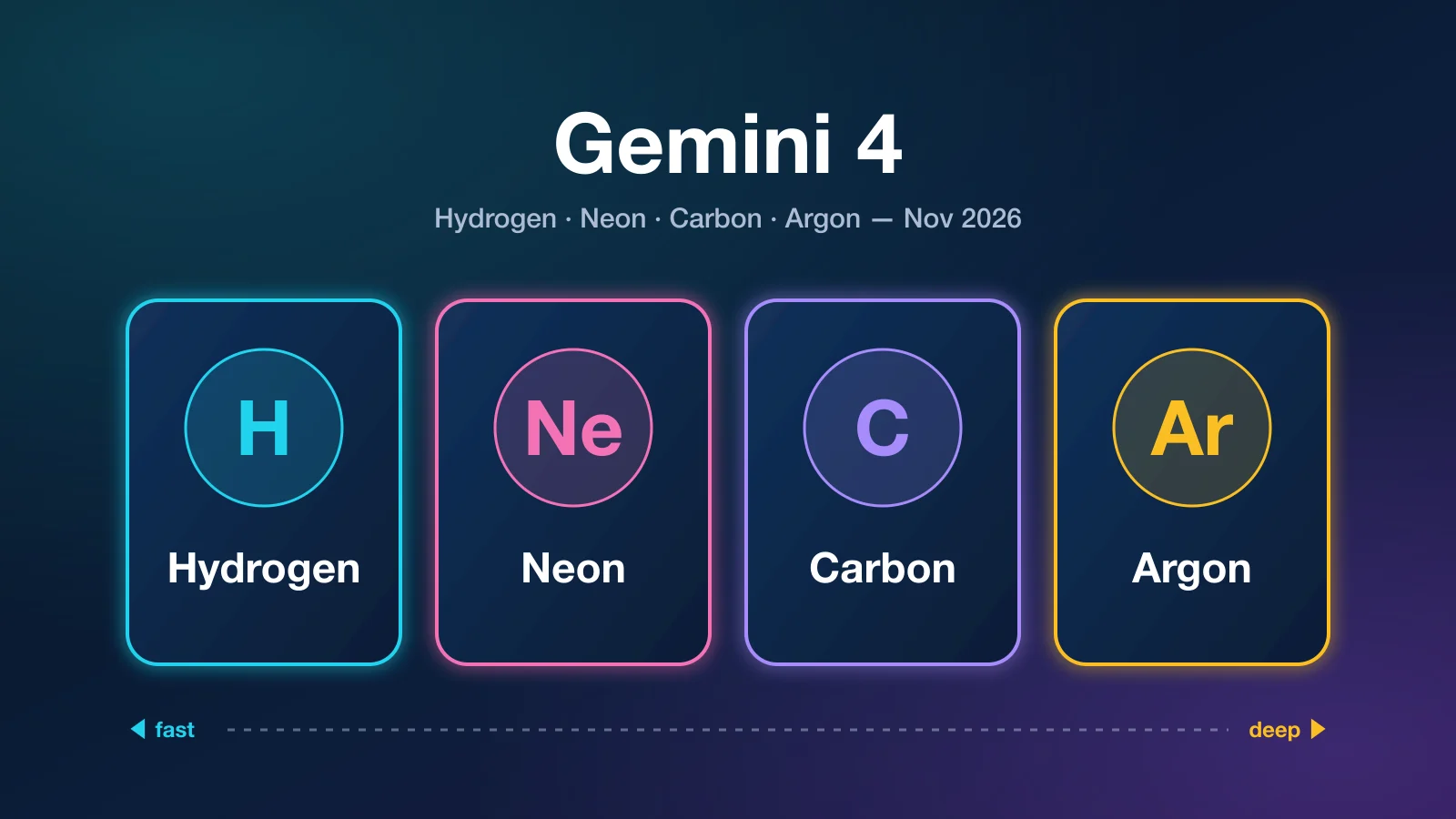
Gemini Hydrogen is Google's Gemini 4 Hydrogen, the fast, lower-cost everyday model in the Gemini 4 family, released on November 12, 2026 for the Gemini app, Google Search, the Gemini API and Google's business products. It is an official product name, not a codename or a rumour. Gemini 4 now has four models named after chemical elements: Argon, Carbon, Hydrogen and Neon. Here is what each one is for, what they cost, which claims are Google's own, how to use them in Japan, and which one to pick for your business.
- What it is: a Gemini 4 model "built for rapid execution across diverse agentic workflows," adapted from Gemini 4 Carbon (Google, model card).
- Released: November 12, 2026 (US time), rolling out globally.
- Model ID:
gemini-4-hydrogen. - Context: 1M tokens shared by input and output; 64K default output, up to 1M with background long decoding. Input: text, images, audio, video, PDF. Output: text.
- Thinking levels: low, medium, high (default) and a new xhigh.
- API price: $1.50 per 1M input tokens, $7.50 per 1M output tokens, flat across the whole context. Free tier available.
- Who gets it: free Gemini app users through Auto, Google AI Plus, Pro and Ultra subscribers, all Google Search users, and developers on every Gemini API tier.
What is Gemini Hydrogen?
Google announced Gemini 4 Hydrogen on November 12, 2026 in a post by Koray Kavukcuoglu, Chief AI Architect at Google (blog.google). Google describes Carbon and Argon as frontier models for "deep, long-horizon reasoning" and Hydrogen as the fast execution model. It can work on its own for everyday tasks, or as the worker inside a multi-model setup. In Google Antigravity, a feature called Orchestrator switches between Carbon and Hydrogen in the same session, with Carbon planning and Hydrogen running worker and checking agents.
Hydrogen does not carry the old "Flash" name, but Google compares it with Gemini 3.8 Flash. Google says Hydrogen finishes tasks 2.5 times faster at its default setting, scores 57% on Terminal-Bench 4.1 against 18.2% for 3.8 Flash, and makes more than five times fewer fabricated claims. Google's model card says Hydrogen is adapted from Gemini 4 Carbon, takes text, image, audio and video input, returns text, and has a knowledge cutoff of March 2026 (model card).
Google's posts that we read do not explain the element names. All four Gemini 4 models use them instead of "Pro" and "Flash", while earlier generations such as Gemini 3.8 Flash and 3.5 Flash-Lite keep the old names.
Every Gemini 4 model compared
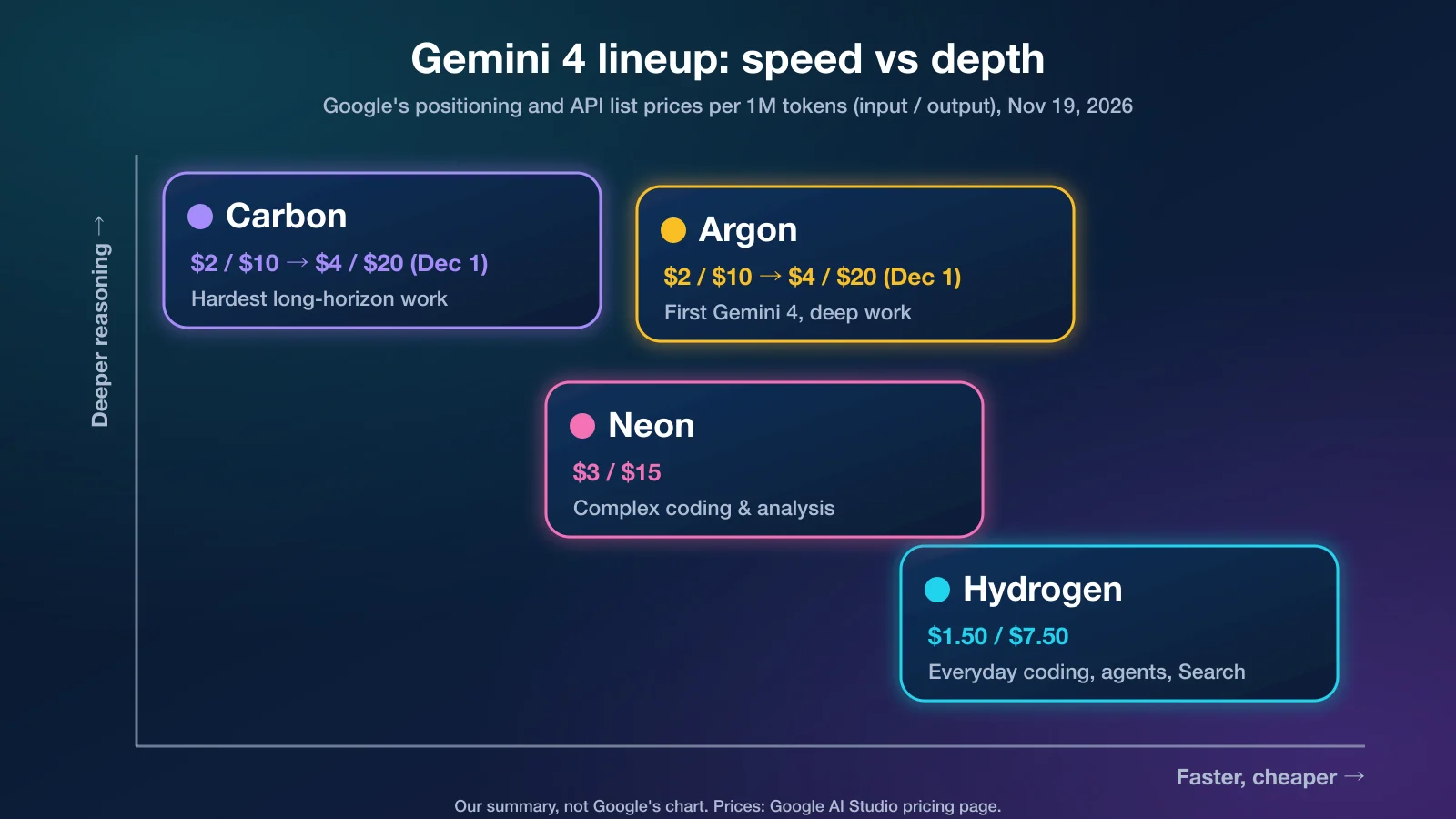
Dates are US time. Positioning is Google's own wording. All four Gemini 4 models list a 1M-token context window and up to 64K standard output in Google AI Studio (model list).
| Model | Released | Google's positioning | Gemini app (Japan plans) |
|---|---|---|---|
| Gemini 4 Hydrogen | Nov 12, 2026 | Fast, efficient everyday coding and agentic workflows | Free (via Auto), Plus, Pro, Ultra |
| Gemini 4 Neon | Nov 18, 2026 | Balances depth and efficiency for complex coding, analysis and enterprise work | Pro, Ultra |
| Gemini 4 Carbon | Announced Oct 28; paid API from Nov 10, 2026 | Strongest model, for the hardest long-horizon tasks and cybersecurity | Ultra |
| Gemini 4 Argon | Announced Sep 30; broad release Oct 13, 2026 | Efficient frontier reasoning for deep work on complex tasks | Not listed on the Japan plan page |
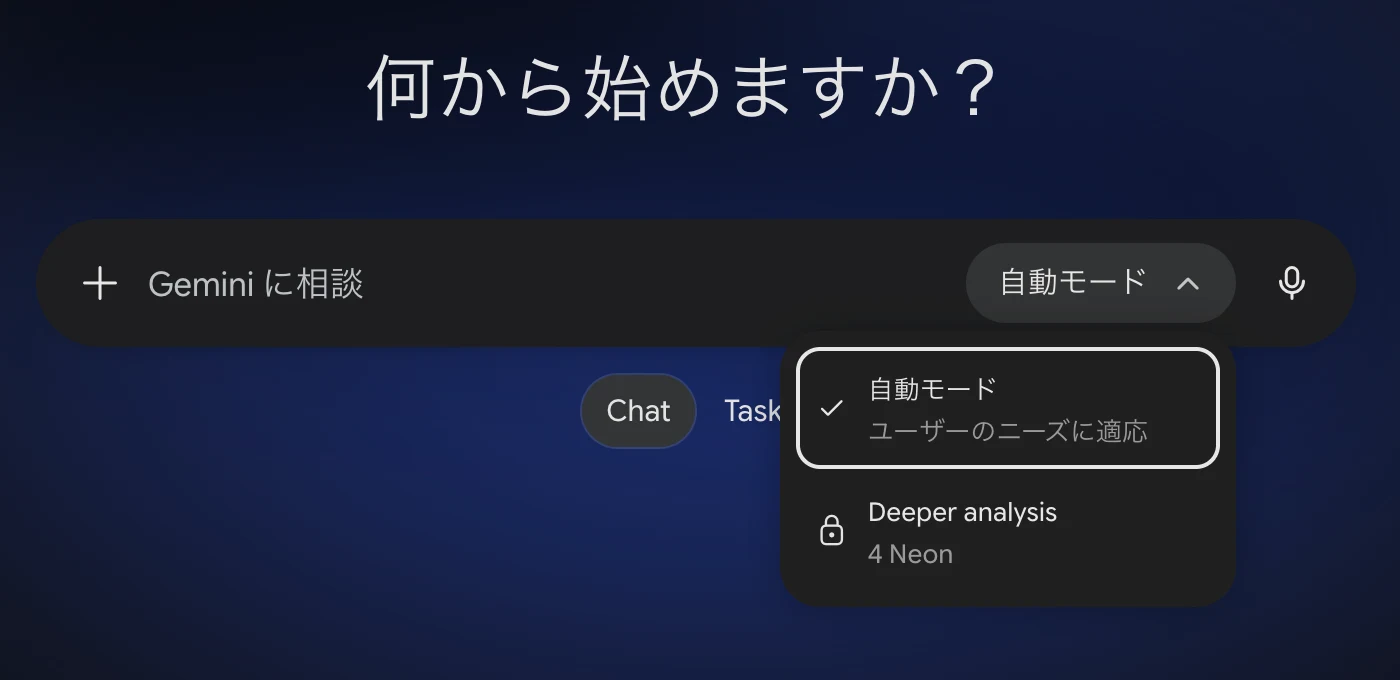
Argon was announced on September 30 for a limited group of cyber defenders (Google Japan blog) and reached developers and Google AI subscribers on October 13 (Google). Carbon started with a small group of cyber defenders on October 28 (Google) and opened to the paid API tier and Google AI Ultra subscribers on November 10 (Google). Neon arrived on November 18 for Google AI Pro and Ultra subscribers and the Gemini API (Google). 9to5Google reports that Neon took Argon's place in the Gemini app's model picker, which in the English UI now shows Auto, "Everyday help" (Hydrogen), "Deeper analysis" (Neon) and "Code & complex work" (Carbon) (9to5Google). Argon remains available in the API.
Google's API also lists older models that are still supported, including Gemini 3.8 Flash, 3.6 Flash and 3.5 Flash-Lite, along with special-purpose models: Gemini Decision 1 for yes/no and scoring decisions, Gemini Omni Flash for short video with audio, Nano Banana for images, and Live and TTS models for voice (Google AI Studio).
Benchmarks: Google's own figures
All the scores below come from Google's posts and model card. Independent tests may differ, and each figure depends on the thinking level and the date of the test.
- Artificial Analysis Intelligence Index: Hydrogen 51 at high (default) and 54 at xhigh, against 50 for Argon (Nov 12). Carbon was #1 at 59 on v5.0 when Google announced it (Oct 28). Neon scored 61 at xhigh, #3 overall, on Nov 18. Those are different dates and settings, so they are not a straight ranking.
- Neon: Terminal-Bench 4.1 65.2%, HLE-Diamond 71.3%, #1 on the Artificial Analysis Coding Agent Index at 58.6, #2 on the Vals Index at 70.9% (Google).
- Carbon: SEC-bench Pro 88.2% and ExploitGym 54.8% for finding and exploiting software vulnerabilities (Google).
Google's Hydrogen model card compares it with Anthropic's Claude Sonnet 5.5 and OpenAI's GPT-6.1 Terra. Hydrogen leads most rows, but not all:
| Benchmark (Google's model card) | Gemini 4 Hydrogen | Claude Sonnet 5.5 | GPT-6.1 Terra |
|---|---|---|---|
| HLE-Diamond | 58.8% | 53.3% | 47.3% |
| Agents' Last Exam v1.1 | 71.6% | 60.4% | 69.8% |
| AutomationBench-AA | 76.1% | 71.8% | 60.2% |
| MKA (multimodal knowledge agent) | 53.4% | 52.0% | 43.8% |
| Terminal-Bench 4.1 (cheating-adjusted) | 57.0% | 63.9% | – |
| OSWorld-2.1 (offline subset) | 77.6% | 83.9% | 74.2% |
| Terminal-Bench-Science 0.1 | 51.4% | 59.9% | 58.3% |
The model card also notes weaker spots against Gemini 3.8 Flash: unjustified refusals rose by 5.57 points, mostly on prompts with images, and tone scored slightly lower (model card).
Gemini API pricing (per 1M tokens)
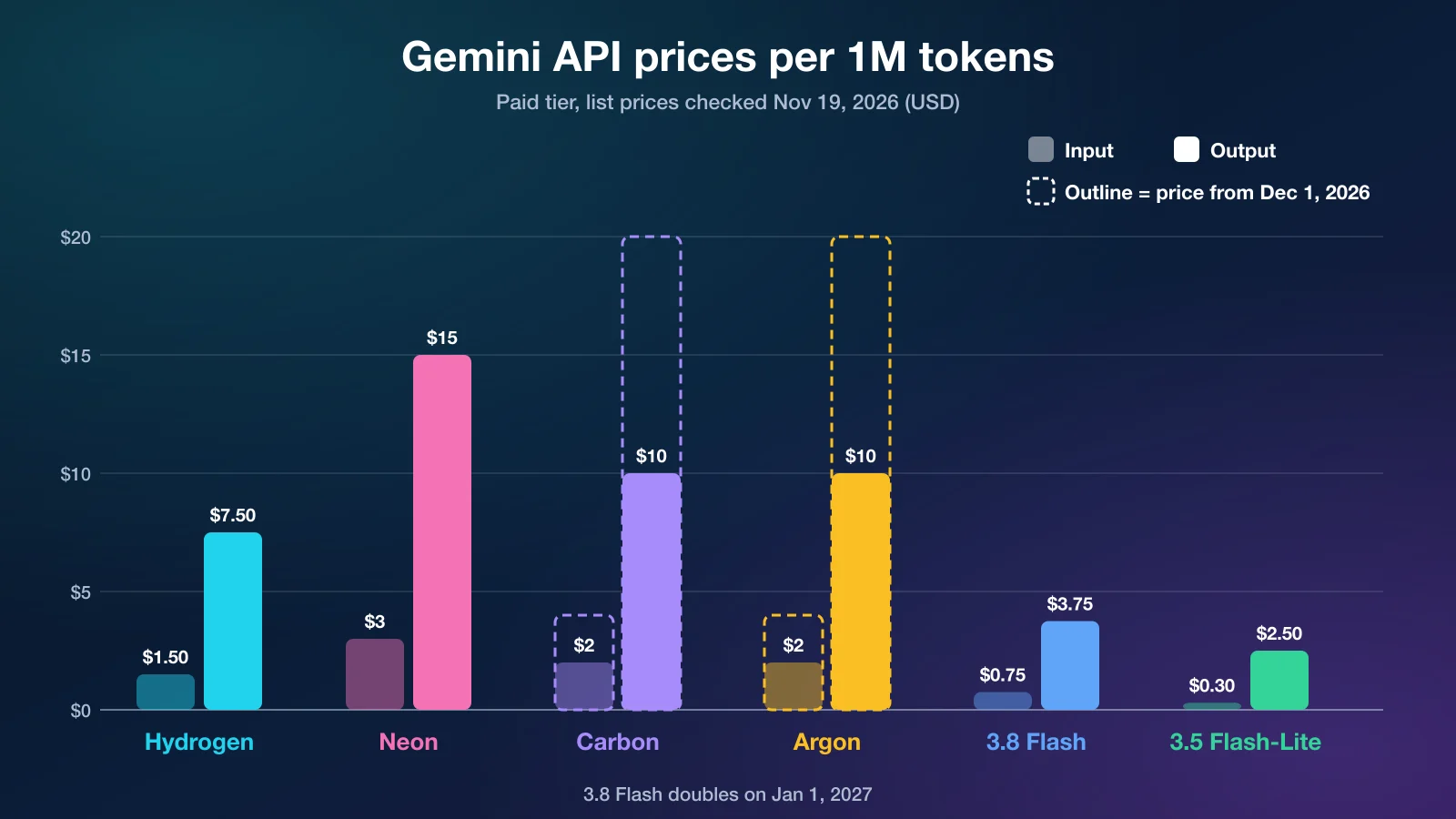
Standard paid-tier prices in US dollars from Google's pricing page (Google AI Studio). Two price changes are scheduled: Carbon and Argon double on December 1, 2026, and Gemini 3.8 Flash doubles on January 1, 2027. For the Gemini 4, 3.8 Flash and Flash-Lite models, Batch processing costs half; Decision 1 has no Batch API.
| Model | Input | Output | Cached input | Free tier | Scheduled change |
|---|---|---|---|---|---|
| Gemini 4 Hydrogen | $1.50 | $7.50 | $0.075 | Yes | None listed |
| Gemini 4 Neon | $3.00 | $15.00 | $0.15 | No | None listed |
| Gemini 4 Carbon | $2.00 | $10.00 | $0.10 | No | $4.00 / $20.00 from Dec 1, 2026 |
| Gemini 4 Argon | $2.00 | $10.00 | $0.10 | No | $4.00 / $20.00 from Dec 1, 2026 |
| Gemini 3.8 Flash | $0.75 | $3.75 | $0.075 | Yes | $1.50 / $7.50 from Jan 1, 2027 |
| Gemini 3.5 Flash-Lite | $0.30 | $2.50 | $0.03 | Yes | None listed |
| Gemini Decision 1 | $0.10 | No output tokens | – | Yes | None listed |
Until November 30, Neon costs more than Carbon. From December 1, Neon becomes the cheaper frontier option at $3 / $15 against Carbon's $4 / $20. Gemini 4 prices are flat across the full 1M-token context, and Gemini 4 caching is implicit only. Grounding with Google Search on Gemini 3 and newer includes 5,000 free requests a month, then costs $14 per 1,000 requests.
If you still call older models, note that Google will route requests for gemini-2.5-pro to Gemini 3.8 Flash, and gemini-2.5-flash to Gemini 3.5 Flash-Lite, on December 1, 2026 (Google AI Studio). Test your prompts before then.
Gemini in Japan: plans, availability and data location
Google says Hydrogen is "rolling out globally across our developer, enterprise, and consumer surfaces" (Google) and is available "globally in Google Search for all users" (Google Search blog). Neither post lists a separate date for Japan. Google's Japanese plan page showed these prices and models on November 19, 2026 (gemini.google):
| Plan | Monthly price (Japan) | Gemini 4 models listed |
|---|---|---|
| Free | ¥0 | Hydrogen through Auto model selection |
| Google AI Plus | ¥725 | Hydrogen |
| Google AI Pro | ¥2,900 | Neon, Hydrogen |
| Google AI Ultra | ¥14,500 or ¥32,000 | Carbon, Neon, Hydrogen (highest limits) |
For companies, two points matter in Japan:
- API access: Hydrogen is on every Gemini API tier in Google AI Studio, including the free tier. Before you send customer or company data, check Google's data-use terms for the tier you use; for business data, the paid tier is the usual choice.
- Data location on Google Cloud: on Gemini Enterprise Agent Platform (formerly Vertex AI), Hydrogen is generally available, but its model page listed only the
globalendpoint andusandeumulti-regions when we checked, with machine-learning processing residency in the US and EU (Google Cloud). We found no Tokyo (asia-northeast1) listing. If your contracts require data to be processed in Japan, check this before you build. Neon was not yet on Google Cloud's model list on November 19 (Google Cloud).
Which Gemini model should your business use?
This is our view, based on Google's positioning and prices. Test your own tasks before you commit.
| Job | Start with | Why |
|---|---|---|
| Staff chat, email drafts, summaries | Hydrogen | Fast, cheapest Gemini 4 model, included even in the free and Plus tiers (Gemini in Google Sheets starts with Pro and Ultra) |
| Customer support bots and high-volume API work | Hydrogen | Flat $1.50 / $7.50 price across 1M tokens; set thinking to low or medium for speed |
| Everyday coding, website fixes, prototypes | Hydrogen | Google's target use; use high or xhigh for harder bugs |
| Financial, legal or data analysis; complex coding | Neon | Google's middle model; becomes cheaper than Carbon from Dec 1 |
| Hardest multi-day engineering, security review | Carbon | Google's strongest model; Ultra or paid API only |
| Yes/no checks, routing, classification at scale | Gemini Decision 1 or 3.5 Flash-Lite | Far cheaper per request; Decision 1 returns no output tokens |
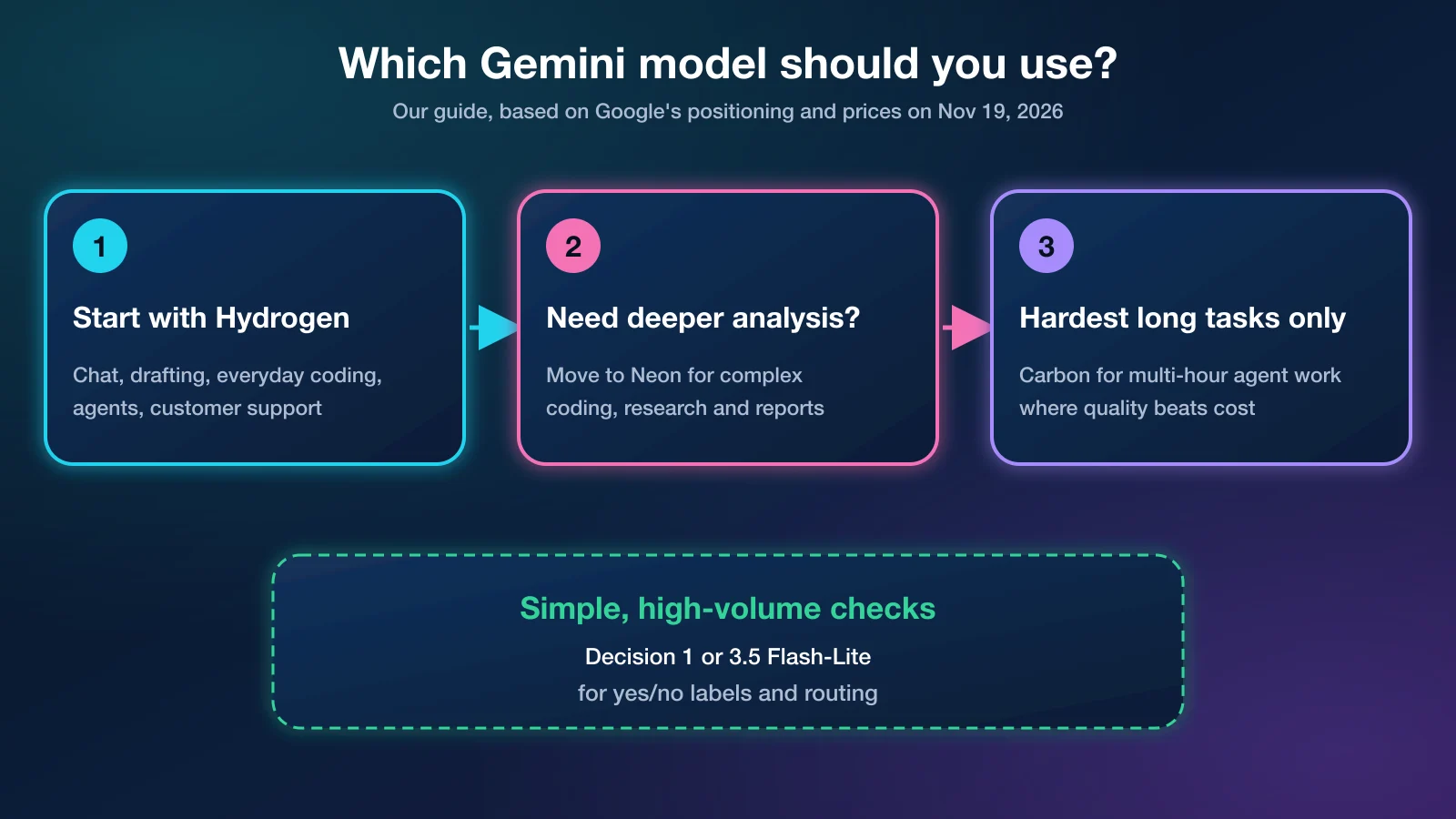
A practical pattern is the one Google itself uses in Antigravity: let a stronger model plan, and let Hydrogen do most of the work. Keep an eye on the December 1 price change if you use Carbon or Argon, and review your migration plan if anything still calls Gemini 2.5.
FAQ
What is Gemini Hydrogen?
Gemini Hydrogen is Gemini 4 Hydrogen, Google's fast, lower-cost everyday model in the Gemini 4 family. Google released it on November 12, 2026 (US time) in the Gemini app, Google Search, the Gemini API, Google AI Studio and Gemini for business. It is an official model name, not a codename.
Is Gemini Hydrogen free?
Partly. Free Gemini app users get Hydrogen through Auto model selection when it suits the prompt, and Google says Hydrogen powers Google Search for all users. The Gemini API has a free tier for Hydrogen; the paid tier costs $1.50 per million input tokens and $7.50 per million output tokens.
What is the difference between Gemini Hydrogen, Neon, Carbon and Argon?
Google positions Carbon as its strongest model for the hardest long-horizon work, Neon as the balance of depth and efficiency for complex coding and analysis, and Hydrogen as the fast model for everyday coding and agentic workflows. Argon was the first Gemini 4 model, built for deep work on complex tasks, and is still offered in the API.
Does Gemini Hydrogen replace Gemini Flash?
Google benchmarks Hydrogen against Gemini 3.8 Flash and says it finishes tasks about 2.5 times faster at its default setting. Google has not used the Flash name for Hydrogen, and 3.8 Flash is still listed as a stable, previous-generation model in the API.
What is Gemini Hydrogen's context window?
1 million tokens, shared between input and output. By default it returns up to 64K output tokens per request, and up to 1 million output tokens through background long decoding, according to Google's model card.
Can I use Gemini Hydrogen in Japan?
Yes. Google says Hydrogen is rolling out globally, and Google's Japanese plan page lists it for Google AI Plus (¥725 a month), Pro (¥2,900) and Ultra (from ¥14,500). On Gemini Enterprise Agent Platform (formerly Vertex AI), the model page listed global, US and EU endpoints when we checked, with no Tokyo region.
Adding Gemini or another AI model to your business?
We help Tokyo companies choose the right AI model, build chatbots, document search and AI features into websites and apps, and keep data and API keys secure, in English and Japanese. Book a free consultation.
Sources
Google, Koray Kavukcuoglu, "Introducing Gemini 4 Hydrogen", Nov 12, 2026 (updated Nov 16); Google, "Gemini 4 Hydrogen: everyday coding and agentic workflows for developers", Nov 12, 2026; Google, Robby Stein, Gemini 4 Hydrogen in Google Search, Nov 12, 2026; Google DeepMind, Gemini 4 Hydrogen model card, Nov 12, 2026; Google, "Introducing Gemini 4 Neon", Nov 18, 2026; Google, "Introducing Gemini 4 Carbon", Oct 28, 2026, and Carbon for developers, Nov 10, 2026; Google Japan, "Gemini 4 Argon:フロンティア知能の新時代", Oct 1, 2026 (JST); Google, "Gemini 4 Argon: Built to solve your hardest problems", Oct 13, 2026; Google, Gemini Decisions API, Nov 11, 2026; Google AI Studio models and pricing pages; Google Cloud Google models and Gemini 4 Hydrogen pages; Google Gemini plans (Japan); 9to5Google on Hydrogen (Nov 12) and Neon (Nov 18); ITmedia NEWS, Nov 13, 2026. Google pages checked on Nov 19, 2026 (JST). Benchmark figures are Google's own. Graphics are ours and use names only. IT Support in Tokyo is not affiliated with Google. Gemini, Google AI Studio and Google Antigravity are trademarks of Google LLC; Claude is a trademark of Anthropic; GPT is a trademark of OpenAI.
Related: More tech news · OpenAI Codex models compared · How to get your business into AI search