ChatGPT 5.5 vs Claude Fable 5: Honest Benchmarks for Business AI Adoption
Key takeaways
A researched comparison of ChatGPT 5.5 and Claude Fable 5 for Japanese companies planning AI adoption, app development, automation, coding, support, and LLM strategy.
Short answer: both ChatGPT 5.5 and Claude Fable 5 are serious frontier models, but they should not be judged from one headline benchmark. For a Japanese company planning AI adoption, the better question is not "which model wins the internet?" It is "which model performs reliably on our documents, our code, our support questions, our compliance rules, and our Japanese-English workflows?"
What the Release Research Shows
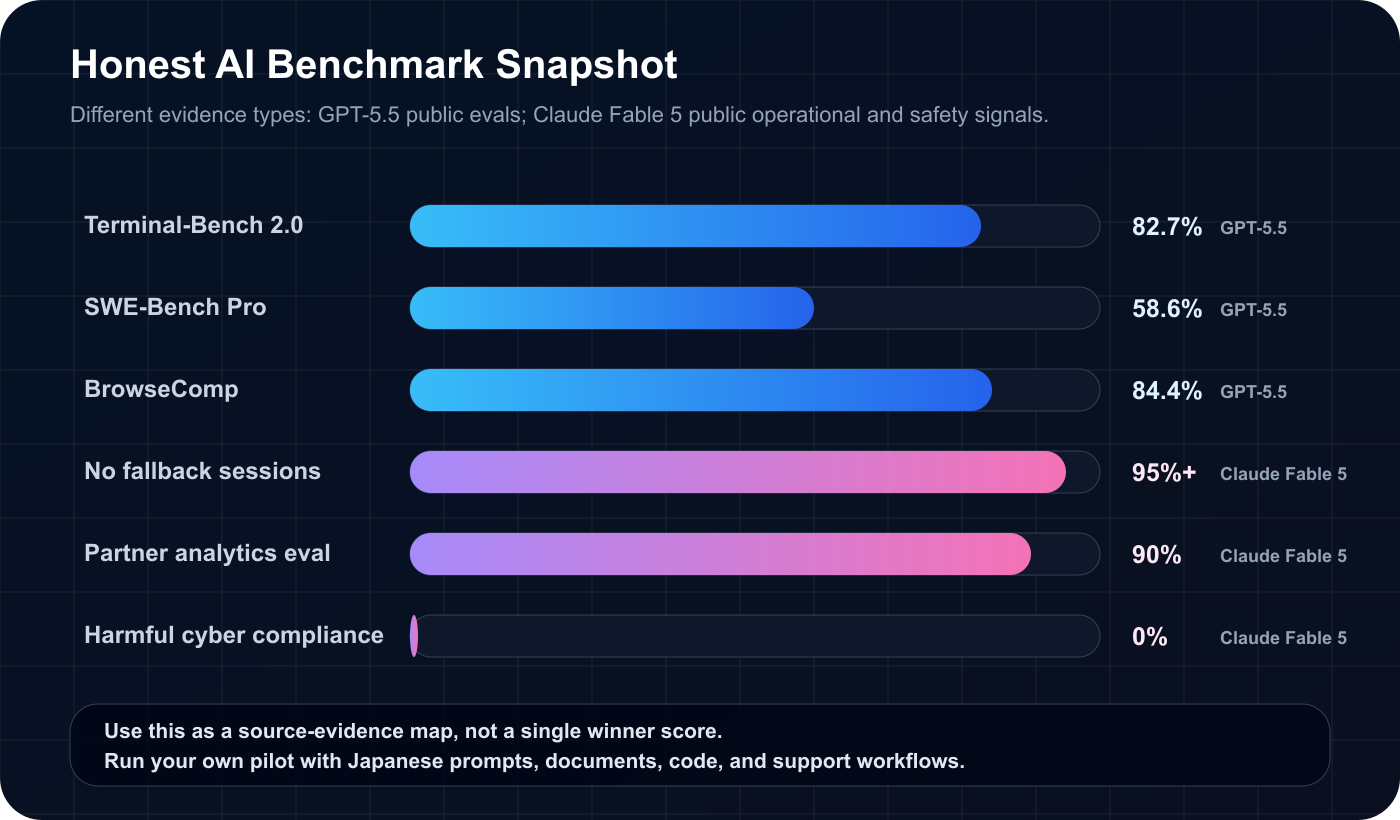
OpenAI's GPT-5.5 release gives unusually clear numeric benchmark data. OpenAI reports GPT-5.5 at 82.7% on Terminal-Bench 2.0, 58.6% on SWE-Bench Pro, 84.9% on GDPval, 78.7% on OSWorld-Verified, and 84.4% on BrowseComp. Those are useful signals for agentic coding, computer-use tasks, business work, and research-style browsing.
Anthropic's Claude Fable 5 release is framed differently. Anthropic describes Fable 5 as a Mythos-class model made safe for general use, with state-of-the-art performance on nearly all tested AI capability benchmarks. The company highlights software engineering, knowledge work, vision, scientific research, memory, long-context work, and long-horizon autonomy. It also says Fable 5 falls back to Claude Opus 4.8 on certain cybersecurity, biology, chemistry, and distillation requests, with more than 95% of sessions involving no fallback.
That matters because the comparison is not perfectly symmetrical. OpenAI published many numeric table values in readable text. Anthropic published strong benchmark claims and partner feedback, but some of the benchmark table is represented as an image. A serious buyer should avoid pretending those are the same kind of evidence.
What ChatGPT 5.5 Looks Strong For
GPT-5.5 looks especially strong when the task requires planning, tool use, code changes, debugging, web research, documents, spreadsheets, and long multi-step workflows. For a Tokyo business, that maps well to internal automation, technical SEO audits, content operations, app QA, data cleanup, and software development support.
The strongest public numbers are useful for engineering teams. Terminal-Bench 2.0 and SWE-Bench Pro are not marketing slogans; they are closer to the kind of messy work developers actually delegate to coding agents. If your company is building a Next.js site, React app, mobile backend, Supabase app, or admin system, GPT-5.5 should be tested on real issues from your repo.
What Claude Fable 5 Looks Strong For
Claude Fable 5 appears built for long-horizon work: reading large context, staying on task, generating complex prototypes, analyzing documents, handling visual tasks, and doing extended reasoning. Anthropic's examples include a large Ruby migration, strong finance and analytics feedback from early customers, and unusually ambitious vision-driven tasks.
For Japanese companies, that can be valuable in consulting workflows: reviewing long requirements documents, comparing vendor proposals, extracting risks from contracts, planning system architecture, summarizing Japanese-English materials, and prototyping internal tools. The caution is that Fable 5's safeguards are intentionally conservative in sensitive areas. That is good for risk control, but companies working in security or biomedical workflows must understand where fallback behavior may appear.
Honest Benchmark Reading
The graph above is not a "winner chart." It is a source-evidence map. GPT-5.5 has public numeric scores on several named benchmarks. Claude Fable 5 has official public statements about benchmark leadership, partner evals, and safety behavior, including the 95%+ no-fallback session signal and zero harmful single-turn compliance in one external partner cyber-safety test.
For executive decisions, the wrong move is choosing a model because one blog post says it is best. The right move is a small paid pilot with your own data. Test Japanese customer support, bilingual sales emails, source-code tasks, invoice extraction, internal manuals, meeting notes, and privacy-sensitive prompts. Then measure quality, time saved, human correction rate, cost, and operational risk.
Recommended Pilot for Japanese Companies
- Customer support: test Japanese FAQ answers, tone, escalation rules, and hallucination control.
- Software development: test bug fixes, refactors, unit tests, and pull-request review on your real codebase.
- Document work: compare summaries of Japanese contracts, proposals, manuals, and bilingual specifications.
- Marketing and SEO: test Japanese SEO article outlines, title tags, meta descriptions, and local search content.
- Operations: test spreadsheet cleanup, report generation, admin workflows, and repetitive back-office tasks.
Which Should You Use?
Use GPT-5.5 when you need strong coding-agent behavior, tool use, structured business work, and OpenAI ecosystem integration. Use Claude Fable 5 when you need long-context reasoning, careful writing, complex analysis, rich document work, and a model that appears especially strong on long-horizon tasks. Many companies should not choose only one. A practical AI stack can route coding, support, documents, and internal analysis to different models based on cost, quality, and risk.
Need an AI Benchmark for Your Business?
If your company is choosing between ChatGPT 5.5, Claude Fable 5, Gemini, or a private AI workflow, contact IT Support in Tokyo. We can design a practical benchmark, test Japanese and English prompts, build AI chatbots, connect your website or app, and help you adopt AI without guessing.